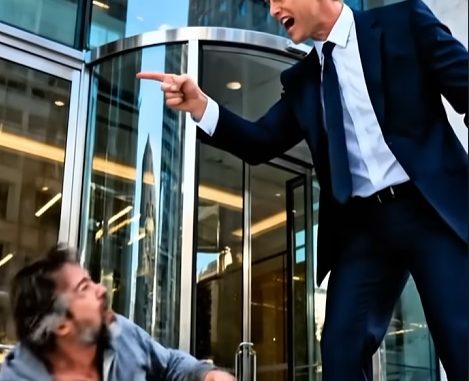
They Humiliated a Homeless Man Outside Their Office—What Happened Next Ended a Career
Every morning, employees rushed through the glass entrance of the towering office building, eyes fixed on their phones, coffee cups in hand. They passed the same man sitting near the steps, but few ever truly noticed him. He blended into the background of their busy routines, as if he were part of the concrete itself.
His name was Daniel Carter.
That morning, Daniel stood up slowly and spoke in a quiet, almost apologetic voice. “Sorry to bother you,” he said. “Could I have a dollar? I just need something to eat.”
The response came fast and sharp.
“It’s you again,” a voice snapped. “I’ve already called the cops on you three times this week. You’re making our company look bad. Leave this property right now.”
Before Daniel could even respond, another man barked orders from a few steps away. “Get security before an investor sees him. Get this homeless piece of trash out of here.”
Daniel lowered himself back onto the cold concrete steps. In his hands was a cardboard sign with simple words written in black marker: Homeless veteran. Anything helps.
Employees walked past him. Some stared. Some smirked. A few pulled out their phones. A group of young tech workers laughed.
“Bet he’ll spend it on drugs,” one of them joked. Someone else whispered that he was being live-streamed.
Then the Vice President, Brad, stepped forward. He crossed his arms, his expression tight with irritation. “I’m done being nice,” he said. “You’re trespassing.”
Without hesitation, Brad kicked Daniel’s cup. Coins scattered across the ground, clinking against the steps. Gasps rippled through the crowd. Brad then ripped the cardboard sign in half and tossed it aside.
“The police are on their way,” he said coldly. “You’re getting arrested.”
Brad had no idea that his career was about to end in less than five minutes.
Daniel Carter was 52 years old that morning. He looked like a man who had lost everything—messy hair, unwashed clothes, the faint smell of days without a shower. To everyone watching, he was just another homeless man who didn’t belong.
What they didn’t know was that Daniel Carter was the founder and CEO of Carter Technologies.
The building behind him belonged to him.
Days earlier, Daniel had received an anonymous email that disturbed him deeply: Your executives treat homeless people in our area like garbage. Instead of dismissing the message, Daniel decided to see the truth for himself. He dressed like this on purpose. He came alone. He wanted to know whether the company’s values—compassion, dignity, respect—were real, or just words framed on the walls.
Watching Brad kick his cup made Daniel’s blood run cold.
Then something unexpected happened.
A young woman named Emma stepped out of the building. She was 26 years old and wore a janitor’s uniform. She had been working there for only three months. She knelt beside Daniel without hesitation.
“Sir, are you okay?” she asked gently.
She gathered the scattered coins one by one. Then she reached into her own pocket and pulled out a ten-dollar bill. “Please take this,” she said softly. She disappeared inside and returned moments later with a cup of coffee and a bagel.
“I got these from the cafeteria,” she said with a small smile.
Brad stormed over, fury written across his face. He grabbed Emma’s arm. “What do you think you’re doing? You’re violating company protocol.”
He pointed toward the doors. “Fire her. Right now.”
Emma didn’t step back. “He’s a human being who needs help,” she said calmly.
Brad’s face turned red. “You’re done. Pack your things. And you,” he said, pointing at Daniel, “the police will be here in two minutes.”
Daniel said nothing. He simply stood up.
And then, for the first time that morning, everyone truly saw him.
At that exact moment, two police officers walked through the glass doors, responding to the call Brad had made with such confidence. The crowd of employees grew quiet. Phones that had been recording moments earlier were slowly lowered. Something in the air shifted.
One of the officers looked at Daniel, then glanced at the torn cardboard sign on the ground, the scattered coins, and the young woman standing protectively beside him.
“Sir,” the officer said respectfully, “are you the individual who requested assistance?”
Before Daniel could answer, Brad stepped forward. “Yes, officers. This man is trespassing and causing a disturbance. We want him removed immediately.”
Daniel calmly reached into his jacket pocket. The movement made several people tense. He pulled out a slim leather wallet and handed the officer an identification card.
The officer studied it for a second.
Then his posture changed.
He looked up again, then back at the card, as if to be absolutely sure. His partner leaned in, read the name, and widened his eyes.
“Sir,” the first officer said carefully, “is this accurate?”
Daniel nodded. “Yes.”
A heavy silence fell over the entrance.
The officer turned to Brad. “You’re speaking to Mr. Daniel Carter,” he said. “Founder and CEO of Carter Technologies.”
The color drained from Brad’s face.
Murmurs rippled through the employees gathered near the doors. Some covered their mouths. Others stared at the building behind them, suddenly realizing who truly owned it.
Daniel finally spoke.
“I received an email,” he said calmly, his voice steady but firm. “It said that people who look like this are treated without dignity outside my company. I didn’t want reports. I didn’t want meetings. I wanted the truth.”
He looked at the torn sign on the ground.
“This morning, I found it.”
Daniel turned toward Emma. “And I also found something else.”
He picked up the broken pieces of the cardboard sign and then looked at her. “Compassion. Courage. Humanity. From someone who had every reason to stay silent—but didn’t.”
Brad opened his mouth to speak, but no words came out.
Daniel turned back to him. “You used the word ‘protocol,’” he said. “Let me be very clear. There is no company policy that allows cruelty. And there is no executive position that excuses it.”
He gestured toward the building. “You’re done here.”
Brad was escorted away, no longer shouting, no longer confident, his authority gone as quickly as it had been misused.
Daniel then addressed the employees watching. “If we claim to be a company built on values,” he said, “those values must apply to everyone—especially the people with nothing.”
He turned to Emma once more. “You’re not fired,” he said gently. “In fact, if you’re willing, I’d like to promote you. We need more people like you here.”
Emma stood frozen, tears welling in her eyes.
Later that day, Daniel ensured that local outreach organizations were contacted and support was arranged for people living on the streets around the building. But more importantly, a message spread through the company—one no memo could ever replace.
Character is revealed not in boardrooms, but in small moments when no one thinks the truth matters.
That morning, a man everyone ignored showed who he truly was.
And a woman with nothing to gain proved what integrity looks like.