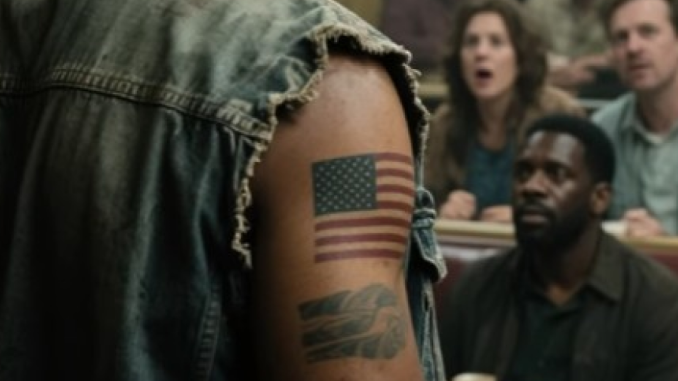
The morning rush at the small roadside diner in Virginia had just settled when the bell over the door chimed, signaling the arrival of two police officers. Their footsteps echoed across the checkered floor as they scanned the room. Most customers barely lifted their heads, but their attention soon shifted toward a man sitting alone in a corner booth. He wore a worn jacket, held a simple cup of coffee between his hands, and carried the tired expression of someone who had spent many nights outside.
His name was Malik Carter—an American veteran who had served his country through two tours overseas and several years in specialized operations. Despite his service, he had faced numerous personal difficulties after returning home, including the challenges of navigating support systems and reintegrating into everyday life. Now, with no stable housing, he found himself stopping at the diner from time to time for warmth, food, and a quiet moment away from the world.
As the officers approached his table, their tone was sharp and dismissive. They questioned why he was there and made assumptions based solely on his appearance. Malik did not respond with anger or confrontation. Instead, he remained calm, hoping the situation would de-escalate.
But when the officers continued to pressure him, even placing a hand on his shoulder as if preparing to remove him from his seat, Malik realized the moment had taken a turn he knew well. He had faced difficulties abroad, and now, unexpectedly, he was confronted with another kind of challenge at home.
With steady hands, he reached for his phone and made a quiet call. He did not raise his voice or cause a scene. He simply contacted someone he trusted — a person who had supported him long before life became unpredictable. The officers brushed off the call, assuming it was insignificant. Malik remained composed, waiting patiently.
Moments later, the diner’s television interrupted its usual programming with an urgent news bulletin. Authorities announced that a major internal review had begun in response to concerns involving the treatment of certain individuals connected to federal service. Although the news did not mention specific names, the timing caused tension to ripple through the room.
The officers’ radios crackled with sudden instructions from their department, urging caution and advising them to disengage from the situation entirely. Confusion spread among the diners as the atmosphere shifted from routine to uneasy.
Soon after, several officials arrived, requesting to speak with the officers privately outside the diner. Malik watched quietly, unsure of what was unfolding but grateful the situation had calmed. What happened next was handled away from the public eye, but it became clear that the events earlier that morning were being reviewed seriously.
Malik stepped outside shortly after, taking in the fresh air as sunlight warmed the street. One of the officials who knew his past service asked gently if he needed assistance or transport. Malik shook his head, offering a small, appreciative smile.
He looked down at the small tattoo on his arm—a symbol of his years in uniform—and then toward the city ahead. He still hoped that one day, circumstances would change not just for himself, but for others facing similar struggles. Despite the challenges he had endured, Malik continued walking with calm determination, ready to face whatever came next.