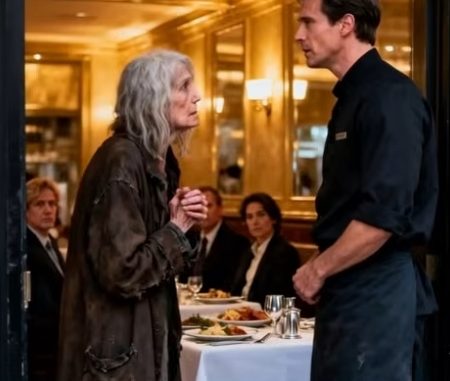
The restaurant sat on a busy street corner in Los Angeles, its wide glass windows revealing a world of comfort inside. White tablecloths stretched across polished tables. Silverware caught the light. Plates arrived heavy with food, laughter drifting easily through the room. It was the kind of place where people came to celebrate, to forget the noise of the city outside.
Just beyond those doors, an elderly woman stood barefoot on the sidewalk.
She was thin and fragile, her gray hair tangled and unkempt, her coat worn thin from years of use. For a long moment, she simply stared through the glass. She watched forks rise and fall, watched servers glide confidently between tables, watched abundance pass by as if it belonged to another world entirely.
Her hands trembled as she finally reached for the door.
When she stepped inside, the noise softened. She cleared her throat and spoke gently to the nearest waiter.
“Sir,” she said, her voice barely above a whisper, “I’m very hungry. Could I please have a meal? I don’t have money, but I can repay you with a prayer.”
The response came quickly—and cruelly.
The waiter laughed out loud. A nearby waitress joined in, shaking her head. Someone muttered that this was a restaurant, not a church. Another voice suggested she pray outside and see if food would fall from the sky. Laughter scattered across the room, light and careless, as if embarrassment were entertainment.
The woman lowered her head. For a moment, it seemed she might turn and leave without another word.
Instead, she paused.
Quietly, almost to herself, she lifted her eyes and whispered, “When the world closes every door, God always leaves the one that truly matters.”
Most people didn’t hear her. But someone did.
In the corner of the restaurant sat a man in a perfectly tailored suit. His name was Michael Rowan—a man known for his success, his discipline, and his carefully built reputation. He had everything people associate with achievement, yet as he watched the scene unfold, he felt something unfamiliar settle in his chest.
An unease. A weight.
He saw the laughter. He saw the way the woman shrank under it. And for the first time in a long while, his carefully ordered world felt painfully hollow.
Michael stood.
The scrape of his chair against the floor drew attention. Conversations slowed as he walked toward the woman, his steps calm, deliberate.
“Ma’am,” he said gently, “would you allow me to have lunch with you?”
The restaurant went silent.
People stared, unsure whether to be confused or offended. This wasn’t how things were done here. This wasn’t the script.
Tears filled the woman’s eyes. “Thank you,” she said softly. “It’s been a very long time since anyone invited me to sit at a table.”
They sat together. Plates were brought. Food filled the table, rich and warm and real. But before taking a single bite, the woman reached for Michael’s hands.
She offered a quiet prayer—not loud, not dramatic, but sincere.
She thanked him for seeing her when others looked away. For choosing kindness when cruelty would have been easier. For remembering her humanity.
Something shifted in Michael then. Not the room, not the light—but him.
When he lifted his head, the seat across from him was empty.
In its place, the white rose resting on the plate caught his eye. Simple. Unremarkable. And yet, impossible to ignore.
Michael didn’t try to explain what he felt. He didn’t claim to understand what had happened. But he knew this: something inside him had broken open.
That day marked a turning point.
He would later say it wasn’t about miracles or signs. It was about recognition. About realizing that compassion often arrives quietly, disguised as inconvenience, discomfort, or a test of character.
The lesson stayed with him.
Because sometimes, the most meaningful moments don’t arrive with applause or power. Sometimes they come in the form of hunger, humility, and a simple request to be seen.
And how we respond—that’s what truly defines us.