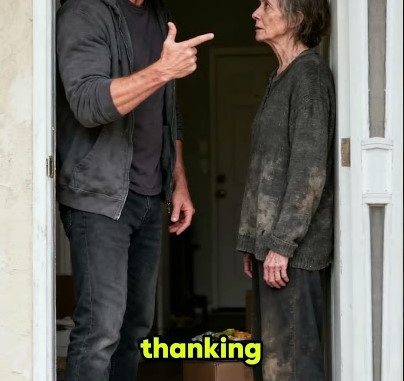
In a quiet apartment hallway, a moment of cruelty passed almost unnoticed—except by the woman who received it.
“Do you really think prayer can put food on the table?” a man sneered, leaning casually against the wall. “If God were real, you wouldn’t be starving like this.”
The woman didn’t respond. She lowered her eyes, said nothing, and gently closed her door.
Her name was Maria Thompson. She was 52 years old, recently laid off after years of steady work. Two weeks without income had drained her savings, and the constant pressure of uncertainty had worn down even her sense of dignity. Life hadn’t just tested her—it had cornered her.
That night, alone in her small apartment, Maria knelt on the cold kitchen floor. Her hands trembled as she whispered a prayer—not for wealth, not for comfort, but for survival.
“God,” she said softly, “I’m not asking for abundance. I just need to make it through tomorrow.”
Across the thin hallway wall lived Daniel Reid. He was sharp-tongued, proud of his skepticism, and quick to dismiss anything he couldn’t see or measure. When he heard Maria praying, he let out a quiet laugh.
“Talking to thin air,” he muttered. “How pathetic.”
But in that moment, Daniel made a decision. Not out of kindness—but out of pride. He wanted to prove one thing to himself: that belief meant nothing, and that no higher power was listening.
Late that night, Daniel walked into a grocery store. He grabbed bread, milk, canned food, and more than he originally planned. Not because he felt compassion, but because he wanted control over the narrative in his own mind.
Early the next morning, while the hallway was silent, he placed the grocery bags outside Maria’s door. He rang the bell and stepped back, hiding just out of sight.
Seconds later, the door opened.
Maria froze. Her eyes widened as she took in the sight of the food. Then her knees gave out. She sank to the floor, tears streaming down her face.
“Thank you, God,” she whispered. “You heard me.”
She carried the groceries inside slowly, one bag at a time, as if each item were something fragile—something sacred. To her, it wasn’t just food. It was hope.
An hour later, Daniel knocked on her door.
“Stop thanking God,” he said with a smirk. “I bought all of that.”
He stepped closer, clearly pleased with himself. “So tell me—where is your God now?”
Maria didn’t argue. She looked at the food in her kitchen, then back at him calmly. She raised her hands slightly, her eyes steady and bright.
“Thank you, God,” she said again.
Daniel frowned. “Are you not listening? I did this.”
Maria nodded gently. “I know.”
Her voice remained calm but firm. “When I prayed, I never asked God how He had to answer. I only asked whether He would.”
She met Daniel’s gaze. “And when God decides to answer, He can use anyone—even someone who doesn’t believe in Him.”
Daniel’s smile disappeared. He had come to mock faith, but instead realized something unsettling: he had become part of the very answer he tried to deny.
Sometimes, help arrives in unexpected forms. And sometimes, belief isn’t about proving anything—it’s about recognizing grace, even when it comes through unlikely hands.
If you believe that hope can arrive in ways we don’t expect, share this story and pass the reminder forward.