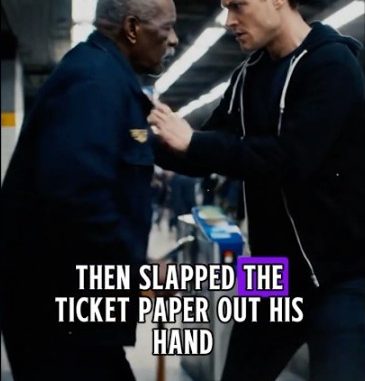
The morning rush at Midtown Transit Station in Atlanta usually moved with practiced indifference. Commuters hurried past one another, eyes fixed on schedules and screens, each person focused on reaching their destination. On this particular morning, however, that routine was broken by a moment that forced everyone nearby to confront a simple question: how do we treat those who move through the world more slowly?
An elderly man named Elijah Brooks, seventy-six years old, made his way toward the ticket counter. He walked carefully, leaning on a wooden cane polished smooth by years of use. His jacket was clean but worn, with a faded patch sewn neatly on the chest—an emblem from long ago. Elijah wasn’t asking for help, wasn’t blocking anyone’s way. He was simply trying to buy a ticket like everyone else.
That’s when a younger man stepped in front of him. Loud enough for others to hear, he told Elijah to move aside, suggesting he didn’t belong at the front. His friends laughed, treating the moment like entertainment rather than a human interaction. A few more comments followed, each sharper than the last, until the station grew uncomfortable with tension.
People noticed. Phones came out. Some looked away. Others shifted their weight, clearly uneasy but unsure whether to intervene. This is often how public moments of disrespect unfold—not because everyone agrees with what’s happening, but because silence feels easier than stepping forward.
The situation escalated when the younger man shoved Elijah, knocking a ticket slip from his hand. The sound echoed more loudly than it should have. Elijah stumbled but did not fall. He didn’t raise his voice. He didn’t retaliate. Instead, he adjusted his collar slowly, deliberately, like someone who had learned long ago that dignity is not something you surrender easily.
Transit officers arrived moments later, asking what had happened. Several witnesses began speaking at once. As the noise swelled, Elijah bent down—not to argue, but to retrieve what had been dropped. Instead of the ticket, he pulled out a small, weathered military tag from his pocket.
The energy in the station shifted. Some of the older passengers recognized it immediately. Their expressions changed, and the whispers that followed were not mocking, but reverent.
Elijah stood straighter and looked at the young man, not with anger, but with calm certainty. He spoke quietly, delivering six words that cut through the chaos: “Ask your father who I am.”
The young man froze.
Elijah then spoke the father’s name, where he lived, and details no stranger should know. Years earlier, overseas, Elijah had pulled that man from a burning wreck under enemy fire and carried him to safety. Because of that moment, a family existed. A son stood there breathing.
The laughter was gone. In its place came tears and shame. The young man apologized, his voice barely audible. Elijah nodded once.
“Don’t be sorry,” he said. “Be better.”
As Elijah walked toward Gate 7, something remarkable happened. People stepped aside—not out of fear, but respect. The path cleared naturally, the way it should have from the start.
Because dignity doesn’t come from youth, strength, or volume. And it certainly doesn’t expire with age.