In today’s fast-paced, hyper-visible world, image often feels like everything. We carefully curate our online presence, choose our words with intention, and present polished versions of ourselves in professional and social spaces. Success is frequently measured by titles, clothing, and outward confidence. Yet beneath all of this, one timeless truth remains unchanged: character is revealed not in moments of recognition, but in moments of anonymity.
A recent short film that gained widespread attention online captures this idea with striking simplicity. Without relying on spectacle or shock, it delivers a powerful reminder that integrity is not about how we appear when others are watching, but how we act when kindness brings no obvious reward.
A Scene of Everyday Contrast
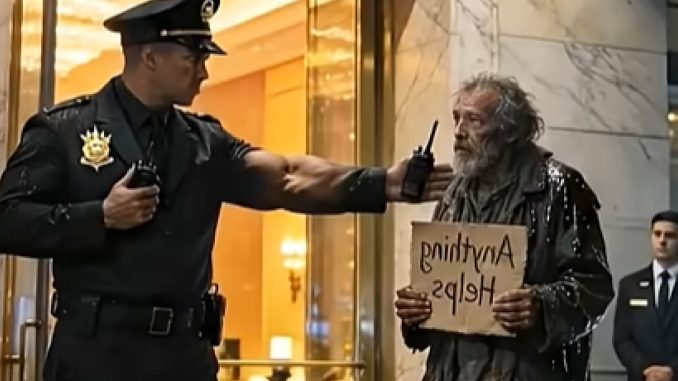
The story opens on a rainy city street outside a luxury hotel. Guests move in and out beneath umbrellas, sheltered from the storm and from discomfort. Near the entrance stands a homeless man, soaked and cold, holding a modest cardboard sign that reads, “Anything Helps.” He does not block the doorway or raise his voice. He simply exists, hoping to be seen.
Instead of compassion, he encounters impatience. A police officer approaches, focused on maintaining order and protecting the image of the establishment. Viewing the man as a problem rather than a person, the officer speaks harshly and forces him away from the entrance.
This moment reflects a familiar societal pattern: the tendency to associate human value with status and appearance. The uniform represents authority, the hotel represents wealth, and the man in the rain represents inconvenience. No laws are broken, yet something essential is lost—basic human empathy.
When Someone Chooses to Stop
As the situation unfolds, a businessman exits the hotel while speaking on his phone. Dressed sharply and clearly busy, he appears to be someone with important places to be. Like many others, he could have walked past without engaging. After all, it would have been easy to tell himself that it wasn’t his responsibility.
Instead, he pauses. He ends the call, steps toward the scene, and intervenes calmly. He speaks respectfully, not with anger or authority, but with clarity. Then, without hesitation, he reaches down and helps the man stand, offering warmth, dignity, and acknowledgment.
This moment defines the heart of the story. The businessman does not act to impress anyone. There is no audience, no praise, and no immediate benefit. His response is guided by an internal compass rather than external pressure. That is what true integrity looks like: choosing compassion even when no one is keeping score.
The Deeper Meaning Behind the Reveal
Later, the story reveals that the homeless man was not who he appeared to be. The situation was a test designed to observe how people behave when faced with someone they perceive as powerless.
While this twist adds drama, it is not the true lesson. In real life, there are no rehearsals and no reveals. Every interaction stands on its own. We rarely know who someone is, what they have endured, or how a single moment of kindness—or neglect—might shape their day or their future.
Why Character Still Matters
Trust Begins with Behavior
People naturally gravitate toward those whose actions align with their values. Integrity builds trust quietly but steadily.
Reputation Is Earned in Small Moments
Public success is often built on private decisions. How we treat those who cannot advance our goals speaks louder than any résumé.
Kindness Creates Culture
One compassionate act can influence an entire environment, encouraging others to act with empathy and respect.
A Simple but Powerful Reminder
The message of this story is not about heroism or judgment. It is about awareness. Every day, we encounter people who are overlooked, dismissed, or underestimated. How we respond in those moments reveals who we are becoming.
You never need a position of authority to lead with integrity. Sometimes leadership looks like stopping, listening, or offering help without being asked.
In a world that often rewards speed and status, choosing empathy is a quiet but powerful act. And while it may not always be noticed, it always matters.
Because in the end, character is not proven by what we achieve—but by how we treat others when no one expects us to care.