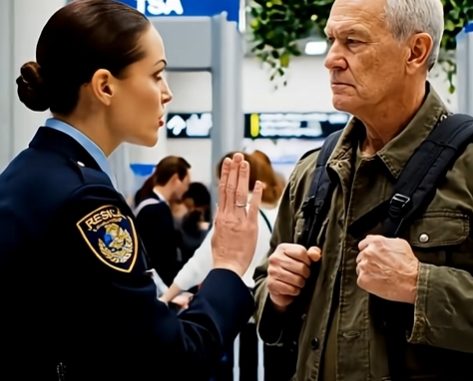
The airport terminal was loud with rolling suitcases, boarding announcements, and the constant movement of travelers rushing to their gates. In the middle of it all, one quiet exchange began to draw attention.
“Sir, step aside,” a security supervisor said firmly.
“I have identification,” the man replied calmly. “I just need to—”
“I said step aside.”
Her voice cut through the noise, sharp enough that nearby passengers slowed their steps. Two officers moved closer as the supervisor, Jessica, gestured toward the man standing in front of the checkpoint.
She pointed at his worn jacket and weathered backpack. “No visible ID. Probably trying to get past security without proper clearance.”
“I do have identification,” the man repeated, his tone even. “You haven’t allowed me to show it.”
Jessica narrowed her eyes. “People don’t just show up at airports like this without a story.”
She turned toward the growing line of travelers. “Everyone, please remain patient. We’re handling a security issue.”
Phones immediately came out. Whispers traveled through the terminal. Someone muttered, “Check his bag.”
At Jessica’s order, the man placed his backpack on the table without resistance. Inside were only basic toiletries and a folded, faded military jacket.
“No wallet. No phone. No ticket,” Jessica said with a satisfied smirk. “Officers, escort him out.”
Before the officers could move, another traveler approached. He wore a tailored suit, a first-class boarding pass tucked neatly in his hand, a polished watch catching the overhead lights.
“Is there a problem here?” he asked.
Jessica straightened instantly. Her voice softened. “Oh, no sir. Not at all. Just a minor security matter.”
She smiled and waved him toward the priority lane. “You’re free to proceed.”
“Appreciate it,” the man replied, already walking away.
The moment he passed, Jessica’s smile disappeared. She turned back to the man with the backpack. “You’re still here?”
The officers stepped forward again.
“You’re invoking Protocol 7-7 Alpha,” the man said quietly. “The three-tier verification system.”
Jessica froze. “How do you know that?”
“I wrote it,” he replied. “Forty years ago. After the 1985 incident.”
The terminal seemed to hold its breath.
He reached slowly into his jacket pocket and removed a military ID, followed by a security badge.
“Airport Authority Board Chairman,” he said, holding it up. “And yes, this jacket belonged to my father. A Vietnam veteran.”
Behind them, the well-dressed passenger stopped mid-stride. His face drained of color.
“General Morrison,” he said under his breath.
Jessica’s clipboard slipped from her hands and clattered onto the floor.
A supervisor hurried over, radio crackling. One look at the badge, the ID, and the phones recording the scene was enough to change his expression.
“General,” he said carefully. “I apologize. I wasn’t aware.”
“You noticed the jacket,” the general replied calmly. “But not the man who wore it first.”
The supervisor turned to Jessica. “My office. Now.”
Jessica’s voice shook. “Please, I can explain.”
“Your badge,” he said, holding out his hand.
With trembling fingers, she unclipped it. The same officers she had summoned moments earlier now stood silently as she was escorted away.
Around them, passengers lowered their phones, though the footage was already being uploaded.
The general picked up his backpack and walked toward his gate without another word. At the end of the jet bridge, a young sergeant waited—returning home to be honored for service overseas.
That, the general knew, mattered more than the stares, the whispers, or the momentary silence he left behind.
True security, after all, isn’t about appearances. It’s about judgment, humility, and remembering that dignity doesn’t come from a uniform, a suit, or a badge—but from how we choose to treat others when no one thinks we’re watching.