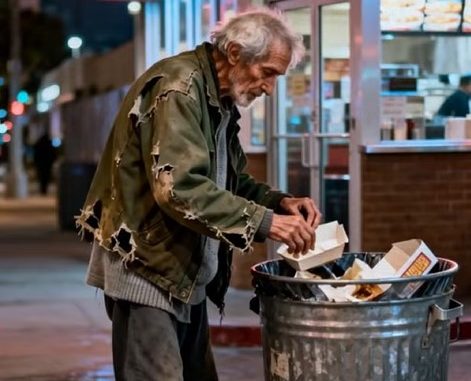
On a quiet afternoon in downtown Los Angeles, an elderly man stood outside a small restaurant, carefully digging through a trash can in search of food. His clothes were worn, his hands trembling from weakness. For him, this was not about pride or embarrassment—it was about survival. He had not eaten a proper meal in two days, and hunger had pushed him to this moment.
As he reached into the trash and pulled out a discarded slice of pizza, a server rushed out of the restaurant. Without hesitation, the server kicked the trash can over, sending food scraps onto the pavement.
“Get away from here,” the server shouted. “This isn’t a charity. You’re scaring our customers.”
Startled and afraid, the elderly man stepped back. His voice shook as he apologized. He explained softly that he was just hungry. Instead of compassion, he was met with impatience and anger. The server told him to leave immediately and not come back.
People passing by slowed their steps. A few watched in silence. No one intervened. No one spoke up. What the server didn’t realize was that this moment—this choice—would soon cost him his job.
The man’s name was Brooks. He was in his seventies and living on the streets. That day, hunger had driven him back to the same spot he had been warned to avoid earlier. As he clutched the slice of pizza, hoping for just a few bites, the server returned once again. This time, his anger escalated. He grabbed Brooks by the collar and demanded that he leave.
Brooks did not resist. He only repeated the same words: he was sorry, and he was hungry.
At that moment, a woman named Claire walked by, carrying a bag of food. She immediately noticed what was happening. Her expression changed as she rushed forward, pushing the server’s hand away from the old man. Without hesitation, she placed the bag of food into Brooks’s arms.
“Please don’t eat from the trash,” she said gently. “This is clean.”
The server scoffed and mocked her for helping, telling her that the restaurant did not serve “people like him.” Claire remained calm but firm. She replied that if the restaurant truly believed that, then the owner should be the one to say it.
Before the server could respond, Claire guided Brooks inside the restaurant. She walked up to the counter and ordered a hot meal for him, making it clear that she would pay. The restaurant grew quiet as Brooks was seated with a steaming plate of pasta placed in front of him.
For the first time that day, he felt hope.
Just as Brooks lifted his fork, the server stormed back into the dining area. In a sudden outburst, he knocked the plate off the table, sending it crashing to the floor. He loudly declared that the restaurant did not welcome people like Brooks.
The old man froze in shock, sinking down as the room fell silent.
Then a deep, steady voice cut through the tension.
“Say that again.”
The restaurant manager, Louis, stood at the doorway. He had seen everything. His eyes moved from the spilled food to the shaken man on the floor. He walked directly to the server and spoke calmly but firmly.
“This is not your restaurant,” he said. “It’s mine. And he is a guest here. You are fired. Leave now.”
The server’s face turned pale. Without another word, he lowered his head and walked out.
Louis immediately turned his attention to Brooks. He helped him up, apologized sincerely, and returned moments later with another hot meal. This time, he placed it carefully on the table.
“This meal is on the house,” Louis said. “I’m truly sorry for what you went through.”
Brooks’s eyes filled with tears. He thanked them again and again, overwhelmed by kindness he hadn’t expected.
Before leaving, Claire told Brooks that he was welcome to return anytime. If he was hungry, all he had to do was knock.
Later that day, the trash can outside the restaurant was removed. In its place, a simple sign was installed:
If you’re hungry, please knock. We can offer you a bowl of soup.
Sometimes, what treats people like trash isn’t a bin on the sidewalk—but a lack of compassion. True dignity is shown when we choose to protect the weakest among us.