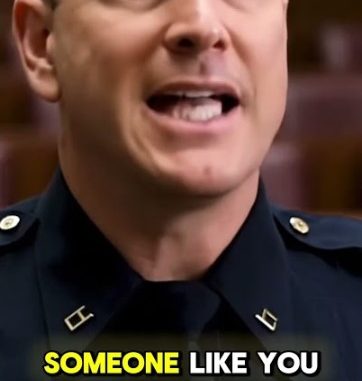
The courtroom was quiet as a veteran police officer took the witness stand. His hand rested firmly on the Bible as he faced the jury with practiced confidence. He spoke clearly, describing a traffic stop that, according to his testimony, had quickly escalated into a dangerous situation. He claimed he feared for his safety and acted according to his training.
This was not his first time testifying. In fact, it was his seventy-third appearance in court, and his record was flawless. Prosecutors listened attentively. Jurors took careful notes. The judge appeared convinced. Everything about the moment suggested that the case was already decided.
Across the room, the defendant sat calmly. She wore a tailored suit and showed no visible emotion—no tears, no panic. Instead, she quietly reviewed her notes, as if she were waiting for something the rest of the room had not yet seen.
As the officer continued, he described his actions in detail, explaining that he believed the situation required immediate restraint. His years of service, his uniform, and his sworn oath all worked together to create an image of credibility. To many in the room, his version of events sounded authoritative and complete.
Then the defense attorney stood.
With measured composure, the attorney asked the court’s permission to present Exhibit A. The lights dimmed slightly as a screen lowered behind the witness stand. What followed would change everything.
The video began playing.
Dash-camera footage from the officer’s patrol car filled the screen. The image was clear. The audio was intact. It showed the defendant’s vehicle traveling within the speed limit before being pulled over. Her hands remained visible on the steering wheel. When asked, she complied immediately, providing her documents without hesitation.
There was no raised voice. No sudden movement. No threatening behavior.
The courtroom grew still as the footage continued. The contrast between the testimony and the video evidence became impossible to ignore. What jurors were seeing did not align with what they had just heard.
When the video ended, the defense attorney called the defendant to the stand—not to testify about the incident, but to introduce herself.
She calmly presented her credentials. A federal badge bearing the seal of the Department of Justice. She explained that she was a senior inspector with the Civil Rights Division and that the traffic stop had been part of a long-running federal investigation. Her decision not to reveal her identity at the time was intentional.
What followed was stunning.
The court was informed that the officer had been under investigation for years and that evidence had revealed a pattern of false testimony. As a result of the investigation, dozens of past convictions connected to his statements were being reviewed and overturned. An entire department was placed under federal oversight to restore public trust and accountability.
The courtroom, once confident and orderly, was silent.
This case became a powerful reminder of why evidence matters, why oversight is essential, and why justice depends not on authority alone, but on truth. In the end, it was not confidence or reputation that decided the outcome—but clear, undeniable facts.
Sometimes, the most important turning points happen when the truth finally has the chance to speak for itself.