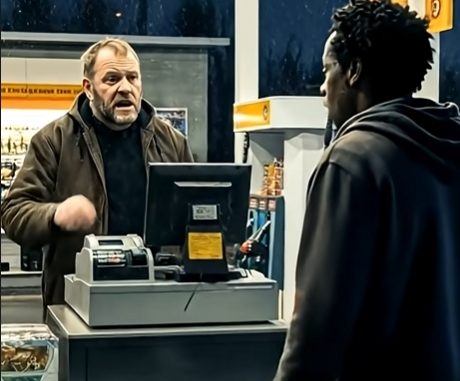
It was just after 1:00 a.m. when James stepped up to the gas station counter. His hands were shaking, his voice low but urgent.
“No money, no gas. That’s the rule,” the owner said flatly, not even looking up.
James swallowed hard. “My daughter has a fever. I need to get her to the emergency room. I lost my wallet at the airport. I’ll come back tomorrow morning, I promise.”
Behind the glass window, Miguel, the night attendant, glanced toward the parking lot. In the back seat of an old sedan lay a small girl, no older than six. Her face was flushed, her breathing uneven. A worn teddy bear rested against her chest. A hospital bag sat beside her, and on her jacket was her name—Mia—embroidered above an emergency contact number.
The station owner, Ron, stepped forward. “I’ve heard this story a hundred times,” he said. “Last week a guy said the same thing. Never came back.”
James pointed toward the car. “Please. She needs help.”
His phone buzzed—2% battery. Then the screen went dark.
Ron turned to Miguel. “You know the policy. If you pump gas for him, it comes out of your paycheck. Sixty-five dollars. Your choice.”
Miguel stood frozen. He checked his bank balance: $180. Rent was due next week—$400. He still needed to send money to his mother in Mexico. Every dollar already had a destination.
Everyone expected him to follow the rules. To stay out of it. To protect himself.
Instead, Miguel pulled out his card and swiped it.
He filled the tank completely—$65. Then he reached into his wallet and pulled out $40 in cash, money he had set aside for groceries.
“Take this,” Miguel said quietly, pressing the bills into James’s hand. “You’ll need parking money at the hospital. Go. Your daughter needs you.”
James couldn’t speak. He just nodded, turned, and drove away.
Thirty minutes later, Miguel was called into the office.
“You paid sixty-five dollars for a stranger,” Ron said, his jaw tight. “You violated policy. You’re suspended for two weeks. No pay.”
Miguel drove home in silence. That night, he sent a message to his mother explaining he couldn’t send money that month. He stared at the ceiling, wondering how one decision could cost so much.
Forty-eight hours later, his phone rang.
“Mr. Santos,” a calm voice said. “This is David Chen, Executive Director at Harborview Medical System. Could you come to the hospital tomorrow at 10:00 a.m.? It’s important.”
Miguel thought it was a mistake.
The next morning, he sat in a conference room on the sixth floor. A man in a suit stood to greet him. Beside him sat another man—also in a suit.
Miguel recognized him immediately.
It was James.
“I owe you an explanation,” James said gently. “Friday night was real. My daughter, Mia, had a severe ear infection. My wallet really was lost. The car really did run out of gas.”
David Chen opened a laptop. “James Carter is the Chief Operating Officer of Harborview Medical System,” he said. “Eight hospitals. Twelve thousand employees. Six hundred million in annual operations.”
Miguel’s breath caught.
“We’re launching a Healthcare Workers Support Program,” David continued. “Five million dollars to help medical staff facing sudden financial emergencies. We need a director—someone who understands what it means to choose helping others over personal security.”
James extended his hand. “We want you.”
The offer included a $72,000 starting salary, full benefits, and tuition assistance so Miguel could finish his engineering degree. They also reimbursed the $105 he had spent that night.
“And Mia is okay,” James added softly. “Because you got us there in time.”
Miguel had lost two weeks of pay to help a stranger.
Two days later, he was leading a program designed to help thousands of families stay afloat in their hardest moments.
Sometimes the most important decisions are made when no one is watching—when helping someone else means risking your own stability.
If your last hundred dollars could change someone’s life, would you spend it?
For Miguel, that question didn’t just change his night.
It changed everything.