The marble lobby of the opera house glowed beneath crystal chandeliers as guests in tailored tuxedos and elegant gowns filtered in for the evening’s performance of La Traviata. Soft conversations echoed through the space, blending with the quiet anticipation that only a live performance can bring. For most attendees, this was a night of culture, refinement, and tradition.
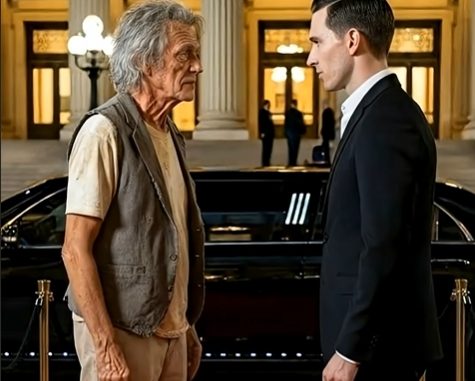
At the entrance stood an elderly man named Thomas Sullivan, seventy-eight years old, with unkempt gray hair and a gentle posture shaped by time. He wore a threadbare vest and faded khaki pants—clothes chosen for comfort rather than appearance. Few people noticed him at first. Those who did quickly looked away.
“I’d like to go in for tonight’s performance,” Thomas said calmly.
The front desk manager, Brandon Foster, finally glanced up. His tailored black suit and polished demeanor contrasted sharply with the man standing before him. His expression tightened.
“This isn’t a shelter,” Brandon replied coldly. “You need to leave before I call the police.”
Thomas did not raise his voice or argue. He simply reached into his jacket pocket and produced a ticket. “I’m seated in A12,” he said.
Brandon laughed sharply. “Where did you get that? Dig it out of someone’s trash?” He shook his head. “Tickets tonight start at four hundred dollars. You clearly wandered in from the street.”
“I’ve been coming here for forty years,” Thomas replied quietly.
Without warning, Brandon stepped forward, snatched the ticket from Thomas’s hand, tore it in half, and dropped it into a nearby trash bin. His voice echoed through the lobby as several patrons turned to watch.
“We have someone harassing guests,” Brandon announced. “Get him out of here before real patrons arrive.”
Phones appeared. Whispers spread. Thomas stood still, his face composed, absorbing the humiliation without protest.
Then footsteps hurried down the grand staircase.
“Brandon, stop this immediately.”
The voice belonged to Katherine Reynolds, the artistic director. Her face had gone pale as she took in the scene. Brandon turned toward her, confident, expecting approval.
“I’m just removing a trespasser,” he said. “He tried to sneak in with a fake ticket.”
Katherine’s voice trembled. “That is Thomas Sullivan.”
The lobby fell silent.
“He founded this opera house,” she continued, her hands shaking. “He donated sixty million dollars to build it in 1985. It was named after him for twenty-five years. He owns forty percent of the shares and has lifetime access to every performance. His name is engraved on the bronze plaque in this very lobby.”
The color drained from Brandon’s face.
Thomas finally spoke again, his voice steady. “I dress comfortably when I come to enjoy music,” he said. “The composers I admire never judged people by appearances. I didn’t expect the staff would either.”
Katherine’s tone hardened. “Brandon, your employment is terminated effective immediately. Security will escort you out.”
Brandon tried to speak, his voice cracking. “Please, this job is all I have—”
But Thomas had already turned away. He walked toward the auditorium entrance without another word, as the music inside began to rise.
That night, Brandon lost his position, his professional standing, and the trust placed in him. The consequences did not come from anger or revenge, but from a failure to uphold the basic principles of respect and dignity expected in any public institution.
The lesson was simple yet profound.
Clothing does not measure character. Appearances do not define worth. And respect should never be conditional.
Because sometimes, the person standing quietly at the door is not there to prove who they are.
They already built the place you’re standing in.