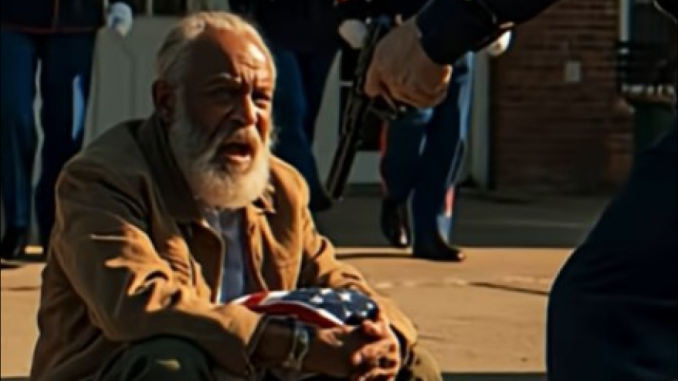
On a quiet afternoon outside a public institution, a man sat alone on the steps, holding a carefully folded flag. His clothes were worn, his posture tired, and to passing strangers he looked like someone the world had forgotten. People walked by without noticing him, some assuming he was simply another person resting outside with nowhere else to go.
But what they could not see was the weight of his memories.
The man was a veteran — someone who had once worn a uniform with pride, someone who had stood in difficult places so others could live in peace. Years had passed since those days, and life had changed in ways he never expected. Like many veterans, he carried stories that were invisible to the outside world.
He sat quietly, thinking about his past — the friendships, the sacrifices, the long nights far from home. In his hands, the folded flag represented more than service. It represented identity, purpose, and a chapter of life that shaped who he was.
At first, the officers who approached the building did not recognize him. From a distance, they saw a tired man sitting alone. Their steps slowed, unsure whether he needed assistance or was simply waiting for someone. There was no tension — only uncertainty, the kind that often comes from not knowing someone’s story.
One officer gently spoke to him, asking if everything was alright.
The veteran looked up, calm but reflective. In that moment, something changed. The conversation revealed pieces of his past — not in dramatic detail, but in quiet honesty. He spoke about his years of service, about what the flag meant to him, and about the people he had served beside.
The officers listened.
Recognition did not come from appearance. It came from understanding.
Their posture shifted. The conversation became respectful, intentional. One officer nodded and spoke words that carried meaning beyond the moment. He thanked the veteran for his service — not as a routine phrase, but as a genuine acknowledgment.
Another officer noticed the flag in the veteran’s hands and encouraged him to hold it high.
It was a simple gesture, yet powerful.
The moment was not about status, uniforms, or titles. It was about dignity. It was about remembering that people carry stories we cannot immediately see. The veteran was not seeking attention. He was simply holding onto a part of his life that still mattered deeply.
What happened next was quiet but meaningful. The officers stood with him for a moment — not above him, not separate from him, but beside him. A small act of recognition turned an ordinary afternoon into something human and memorable.
Stories like this remind us that respect often begins with curiosity. When we pause long enough to listen, we discover that every person has lived experiences that deserve acknowledgment.
The veteran eventually stood, the flag held carefully, his posture slightly stronger than before. Nothing dramatic happened. No crowd gathered. Yet the moment carried weight.
Sometimes dignity is restored not through grand gestures, but through simple recognition.
And sometimes, all it takes is someone willing to look again — and see the person behind the first impression.