In everyday life, moments of misunderstanding can happen quickly. A brief interaction, a rushed judgment, or a simple assumption can shape the way people treat one another. Sometimes those moments pass unnoticed. Other times, they become powerful reminders about respect, patience, and the importance of looking beyond appearances.
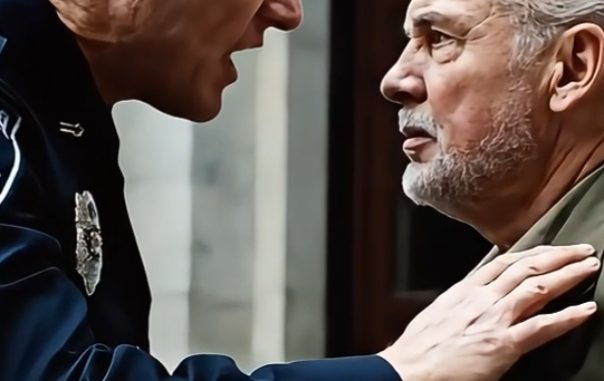
One such moment unfolded when an elderly veteran approached the entrance of a building he had every reason to enter. Dressed in worn clothing and carrying a small case, he moved slowly but with quiet confidence. To most people passing by, he looked like someone ordinary — perhaps even someone out of place.
A police officer standing near the entrance noticed him immediately.
The officer stepped forward and blocked his path, asking where he thought he was going. The veteran answered calmly that he was simply entering. The response did not change the officer’s stance. Instead, the officer questioned whether the man belonged there at all.
The exchange grew tense.
The veteran did not raise his voice. He did not argue aggressively. He repeated that he belonged. His calmness contrasted with the officer’s firm and increasingly dismissive tone. In situations like this, perception often moves faster than understanding. The officer saw appearance first and context second.
At one point, the officer noticed the small case in the veteran’s hands and asked about it. When the case was opened, several medals were revealed — symbols of service, sacrifice, and years of commitment that could not be captured by outward appearance alone.
The atmosphere shifted.
A supervisor arrived and quickly recognized the significance of what was happening. Rather than escalating the situation, the supervisor paused the interaction and looked carefully at the medals. The presence of someone willing to reassess the moment created space for clarity.
The realization was simple but meaningful: the veteran was not out of place. He had a history connected to the very institution he was entering. His story, like many others, could not be understood at a glance.
The officer’s posture changed. The tone softened. What began as a confrontation became a moment of reflection.
An apology followed — not as a dramatic gesture, but as a necessary one. The veteran accepted it with the same calm he had shown from the beginning. His response carried a quiet message that resonated beyond the situation itself: respect should not depend on appearance, and assumptions often hide important truths.
Stories like this resonate because they reflect everyday realities. People move through public spaces carrying invisible histories — experiences, achievements, and challenges that are not immediately visible. When we slow down enough to ask rather than assume, interactions change.
The moment ended without spectacle, but its lesson remained clear.
Respect is rarely about status. It is about awareness. It is about patience. And most importantly, it is about remembering that every person we meet may carry a story we cannot see.
Sometimes, the most powerful shift happens not in dramatic action, but in a simple realization: understanding begins the moment judgment stops.