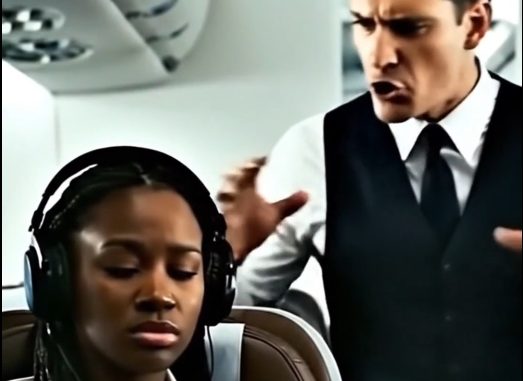
Boarding had just begun, and the first-class cabin carried its usual atmosphere of quiet comfort. Soft lighting reflected off polished surfaces. Passengers adjusted their jackets, placed bags in overhead bins, and settled into wide leather seats.
Among them sat a Black woman in seat 2A.
She moved with calm confidence, placing her handbag under the seat in front of her. Her outfit was simple but elegant — understated, not flashy. She fastened her seatbelt and checked her phone while other passengers boarded.
That’s when a white male flight attendant approached her row.
He stopped beside her seat and looked down.
“You don’t belong here. This plane isn’t for you.”
Several nearby passengers froze mid-motion.
She looked up at him steadily.
“Ma’am, this is first class,” he added, his tone firm.
“Yes, I’m aware,” she replied calmly.
“I’ll need to see your boarding pass.”
Without hesitation, she handed it to him.
He studied it briefly and frowned.
“This doesn’t look right.”
“It was scanned at the gate,” she answered evenly.
“I believe your seat is in economy.”
A quiet murmur moved through the cabin. The tension was no longer subtle.
“My ticket says 2A,” she said, her voice steady but firm. “That’s this seat.”
He straightened his posture.
“I need to double-check this.”
“Please do,” she responded. “I’ll wait.”
The cabin grew unusually quiet as he stepped aside to scan the ticket again using his device. Seconds passed. They felt longer than they were.
Finally, he looked back at her.
“Seat 2A confirmed. First class.”
The silence shifted.
But she didn’t look relieved. She looked composed.
“Just check my badge,” she said calmly, reaching into her bag.
He frowned. “I don’t know who you are.”
She handed him a small identification badge.
He glanced at it — and his expression changed instantly.
“Are you the manager?” he asked quietly.
“Yes,” she replied.
Not just a manager — she was the airline’s regional operations manager conducting unannounced evaluations. She often traveled without advance notice to observe service standards firsthand.
She held his gaze.
“You judged me,” she said calmly. “You judged my status before verifying my seat.”
His earlier authority faded into visible realization.
“You judged me,” she continued, “and in doing so, you represented this airline poorly.”
Nearby passengers were no longer whispering. They were listening.
The flight attendant stood still, absorbing the weight of the moment.
“Professionalism requires verification before accusation,” she said. “Every passenger deserves respect.”
There was no shouting. No spectacle. Just clarity.
His voice softened.
“I apologize.”
She nodded slightly.
“Accountability matters,” she said. “We’ll discuss this after landing.”
The conversation ended there, but the lesson lingered in the air.
She settled back into her seat. The cabin gradually returned to its normal rhythm — but not quite the same as before.
The incident was not about seating. It was about assumptions. About how quickly conclusions can form when someone’s appearance doesn’t match expectations.
By the time the aircraft doors closed, the atmosphere in first class had shifted from tension to reflection.
Respect, after all, is not reserved for certain seats.
And sometimes, the most important upgrades aren’t about comfort — they’re about character.