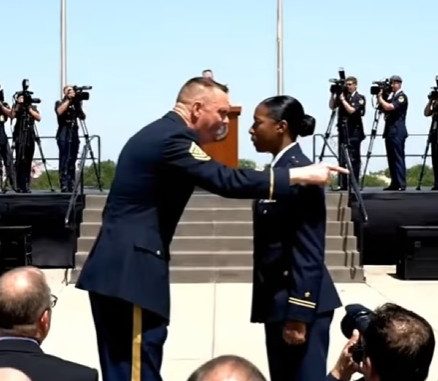
On a bright afternoon filled with flags, polished shoes, and proud families, a ceremony meant to honor decorated service members nearly turned into a lesson about assumption and respect.
Guests were seated. Cameras were ready. The stage was prepared for a formal recognition program dedicated to veterans and distinguished officers. It was supposed to be a moment of unity and gratitude.
Instead, it began with raised voices.
“You are NOT walking up there!” a security officer shouted, stepping directly into the path of an elderly Black veteran and a young woman beside him.
The veteran stopped calmly. “I beg your pardon?”
“This ceremony is for decorated officers,” the officer continued firmly. “Not spectators trying to sneak in.”
The sudden confrontation drew attention. Heads turned. A few phones quietly lifted to record. The veteran remained composed, medals neatly displayed on his jacket. The young woman beside him stood tall but visibly uncomfortable.
“Remove your hand,” the veteran said steadily.
“Or what?” the officer challenged. “Do you have clearance? You seem suspicious.”
The words hung heavily in the air.
“You aren’t aware who I am,” the veteran replied, his voice controlled but firm.
“This is a ceremonial program,” the officer insisted. “I compile the list of people attending. I didn’t see you on it.”
The veteran’s eyes narrowed slightly. “And the way you’ve treated me could affect your own position.”
The officer gestured toward the young woman. “And who is she?”
“She is my daughter,” the veteran responded. “Do not look down on her.”
The exchange grew tense, but the veteran never raised his voice. His posture reflected decades of discipline. He had served at veterans’ funerals, national commemorations, and international deployments. Respect, to him, was not optional — it was foundational.
“I didn’t see her medals,” the officer muttered defensively.
The veteran took a slow breath. “You did not look carefully.”
At that moment, an event organizer rushed forward, alarmed by the scene.
“What is happening here?” the organizer asked.
The security officer responded quickly. “I’m verifying credentials. I didn’t see them on the list.”
The organizer’s expression shifted instantly upon recognizing the veteran.
“Sir, we’ve been waiting for you,” the organizer said respectfully. “He is the keynote honoree today. The entire program was structured around his service record.”
A wave of realization swept through the crowd.
The officer’s posture changed. The tension dissolved into embarrassment.
“I was wrong,” the officer admitted quietly. “Sometimes we should apologize.”
There was no sarcasm now — only humility.
The veteran looked at him for a long moment. Then he nodded.
“Okay. We forgive you,” he said.
The daughter offered a gentle smile, her earlier discomfort replaced by grace.
The officer stepped aside, allowing them to proceed toward the stage. Applause began softly, then grew stronger. What could have been a moment of division became a reminder of something deeper: dignity should never depend on assumption.
Later, the organizer would emphasize the importance of reviewing security protocols to ensure professionalism and fairness. Procedures matter — but so does judgment.
As the veteran approached the podium, the audience rose to its feet. Not just to honor his years of service, but to recognize the quiet strength he demonstrated in that unexpected confrontation.
Respect, after all, is not just earned through medals.
It is revealed in how we treat one another — especially when no one thinks we are watching.