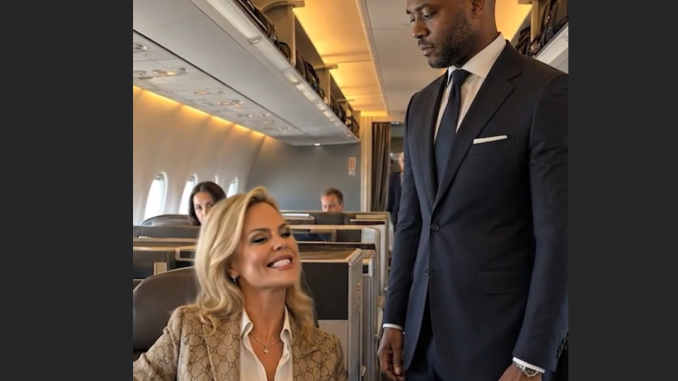
The cabin was quiet as passengers settled into their first-class seats. Soft lights glowed above the aisle, luggage compartments clicked shut, and flight attendants moved carefully between rows. Everything seemed normal until one passenger decided to turn a simple seating issue into a public scene.
A well-dressed Black man stood beside his assigned first-class seat, holding his boarding pass calmly. He had arrived early, checked in properly, and paid for his seat like every other passenger. But when he reached his row, he found a woman sitting there as if the place already belonged to her.
At first, he spoke politely.
“Excuse me,” he said. “I believe this is my seat.”
The woman looked up at him with a smile that was not friendly. Instead of checking her own ticket, she leaned back and acted as if his presence was the problem.
“Oh, please,” she said loudly. “This seat is for classy passengers. People like you usually sit in economy.”
The cabin grew silent. Several passengers turned their heads. A flight attendant stopped near the aisle, unsure whether to step in immediately.
The man remained composed. He showed his boarding pass and said, “I bought this first-class seat legally today.”
But the woman did not stop. She continued speaking loudly, making unfair assumptions about him in front of everyone. She suggested he did not belong in luxury seating and told the flight attendant to remove him because other passengers were “uncomfortable.”
The man took a slow breath. His expression showed disappointment, but not anger. He had dealt with judgment before. He had spent years building his life quietly, choosing discipline over noise and results over attention.
“I spent twenty years building businesses quietly,” he said. “Why humiliate someone publicly during a peaceful flight?”
The flight attendant finally stepped closer and asked to see both boarding passes. The man handed his over immediately. The woman hesitated, then gave hers with visible annoyance.
The truth appeared within seconds.
The woman was not assigned to that seat.
She had taken it and then tried to make the rightful passenger look like the problem.
The flight attendant’s face changed. She looked at the woman and said, “Ma’am, this is not your seat.”
The woman tried to interrupt, but before she could continue, the man spoke again, calmly but firmly.
“Actually,” he said, “I own this airline company.”
The aisle went completely still.
The flight attendant froze. Passengers who had been recording lowered their phones slightly, realizing the situation had changed completely. The woman’s confident expression disappeared.
The man did not shout. He did not insult her. He simply explained the truth.
“She took my seat,” he said. “Then she tried to have me removed from my own plane.”
Within moments, the cabin supervisor arrived. After checking the records, the woman was asked to leave the first-class section and return to her assigned seat. Because of her behavior and refusal to cooperate, the crew documented the incident before takeoff.
The man finally sat down in the seat he had paid for. The cabin remained quiet, but the silence felt different now. It was no longer shock. It was realization.
Some passengers looked embarrassed for staying silent. Others gave him respectful nods. The flight attendant apologized sincerely for what had happened and thanked him for remaining calm.
He accepted the apology, but his final words stayed with everyone nearby.
“Success does not always announce itself,” he said. “And no one should be judged before they are heard.”
The plane eventually departed, but the lesson stayed behind: respect should never depend on appearance, status, or assumptions. The person being judged quietly may be the very person holding the highest seat in the room.