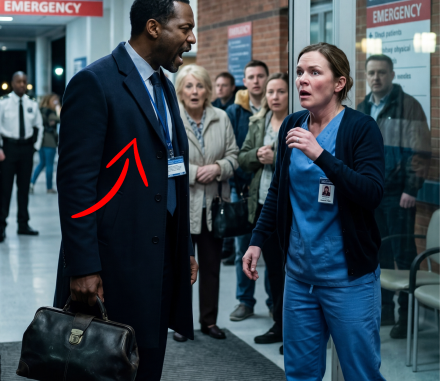
Rain tapped softly against the glass doors of Westbridge Medical Center as people hurried through the hospital entrance. Nurses moved quickly between departments, families waited near the reception desk, and the sound of rolling carts echoed through the bright lobby.
Near the front doors, a calm Black man in a dark coat stepped toward the entrance while carrying a medical bag over his shoulder. He looked tired, as if he had already worked through a long day, but before he could walk inside, a nurse suddenly stepped in front of him.
“You can’t enter this place,” she said sharply.
The man stopped and looked at her with surprise.
“This is a priority hospital,” the nurse continued. “Get your bag and move away from the door.”
People nearby turned their heads. A few visitors paused near the waiting area, unsure why the nurse was speaking to him that way.
The man remained calm.
“I am where I belong,” he replied.
But the nurse did not move.
“You don’t know me,” the man added quietly.
She crossed her arms and raised her voice.
“You either move away from the door, or I will call security.”
The lobby became uncomfortable. Some staff members slowed down. A family sitting near the entrance watched in silence. The man could have shouted back, but he did not. Instead, he took a slow breath and kept his voice steady.
“It’s better to call the manager of the hospital,” he said.
The nurse gave a short, confident laugh.
“Fine,” she answered. “I’ll call the manager of the hospital.”
A few minutes later, the hospital manager hurried toward the entrance. He looked serious at first, expecting to handle a disturbance near the front doors. But as soon as he saw the man standing there, his expression changed completely.
He stopped in place.
“Doctor Williams?” the manager said with clear surprise.
The nurse looked confused.
The man nodded respectfully.
The manager turned toward the nurse and spoke carefully.
“Do you understand who this is?”
The nurse said nothing.
The man finally looked at her and spoke loud enough for the people nearby to hear.
“Because I am not just a Black man,” he said. “I am a senior doctor here.”
The entire entrance area fell silent.
The nurse’s confidence disappeared immediately. The people watching understood what had happened. She had judged him before asking who he was, before checking his identification, and before treating him with the basic respect every person deserves.
The manager apologized to Doctor Williams and personally escorted him into the hospital. He explained that Doctor Williams had served the hospital for years, trained younger doctors, and helped countless patients during difficult emergencies.
The nurse apologized as well, admitting she had acted too quickly and made the situation worse in front of patients and staff.
Later that evening, the incident became a serious reminder inside the hospital. Professionalism is not only about uniforms, badges, or job titles. It is also about how people treat others when they think nobody important is standing in front of them.
Doctor Williams did not need to shout to prove who he was. His calm response said more than anger ever could.
By the end of the night, the hospital lobby returned to normal. Patients were helped, families were guided, and staff continued their work. But the people who witnessed that moment remembered one clear lesson:
Never judge someone at the door before you know who they truly are.