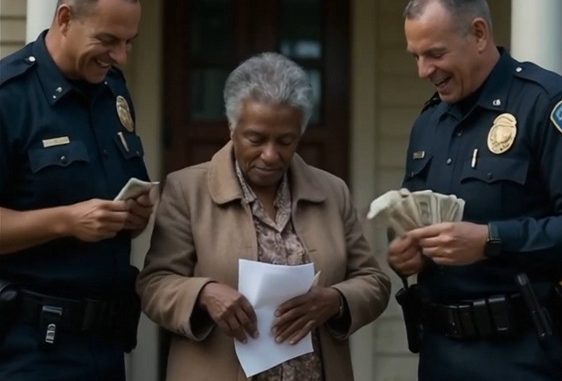
Dorothy Williams was known in her town for her warm smile, her homemade pastries, and the tiny neighborhood bakery she had run for nearly three decades. At sixty-eight, she lived a simple and honest life, spending her days serving loyal customers and her evenings visiting family. Nothing about her seemed extraordinary—until one unexpected incident changed more than just her routine drive home.
It was a quiet evening when Dorothy locked up her bakery, placed the day’s earnings—about $3,200—in a sealed envelope, and headed toward her house a few miles away. The roads were nearly empty, and she drove carefully, as she always did. But halfway home, she noticed police lights flashing in her rearview mirror.
Officers Derek Stone and Mike Harrison approached her car, explaining that one of her tail lights appeared to be malfunctioning. Dorothy, polite and cooperative, complied with every instruction. She handed over her license, explained she was returning from work, and remained calm throughout the stop.
During the conversation, the officers asked whether she had anything in the vehicle they should know about. Wanting to be transparent, Dorothy mentioned the envelope of bakery earnings she planned to deposit the next morning. The officers asked to look inside her vehicle, and Dorothy agreed, trusting that everything would be fine.
When the officers found the envelope of cash, the situation quickly grew confusing. They questioned why she was carrying such a large amount and suggested it might be connected to suspicious activity. Dorothy immediately explained the money belonged to her bakery and even offered to show her sales receipts. Still, the officers insisted the funds needed to be “held for verification.” Feeling overwhelmed but wanting to avoid conflict, Dorothy cooperated, believing there must have been a misunderstanding.
What the officers didn’t know was that Dorothy’s son, Marcus, had installed a small dashboard camera months earlier to make sure she felt safe driving at night. When Dorothy returned home and told him what happened, he checked the footage to better understand the situation.
Marcus worked for the National Bureau of Internal Affairs, an internal oversight organization designed to review complaints and ensure that public-facing agencies follow proper procedure. When he watched the recording, he realized that the stop appeared unusual, and the handling of Dorothy’s earnings did not follow standard protocol.
Marcus filed the situation for official review, and over the next two days, internal investigators began quietly examining previous reports, community feedback, and procedure records related to the officers involved. The review found several inconsistencies in past stops, which led the oversight team to schedule a controlled assessment to verify compliance.
To ensure a fair and thorough investigation, Marcus volunteered to participate in a supervised field test designed to evaluate officer conduct during routine stops. During this assessment, oversight personnel observed interactions carefully, allowing them to gather objective documentation of how procedures were followed.
When all evidence was collected, supervisors concluded that multiple officers in the precinct required retraining on proper handling of traffic stops, communication, and documentation of confiscated items. The department implemented corrective actions, updated guidelines, and provided additional community-relations training.
Dorothy eventually received her bakery earnings back after verification, along with an apology from the department. At a public meeting, she spoke softly but confidently, reminding officials and residents that “respect and honesty make every community stronger.”
Her story spread throughout the town—not because of anger, but because of how calmly and courageously she handled the situation. Dorothy became a symbol of patience, integrity, and how one person’s willingness to speak up can help improve systems for everyone.
In the end, a simple traffic stop led to positive change, and Dorothy’s quiet strength helped ensure future interactions in her community were fairer, clearer, and more transparent for all.