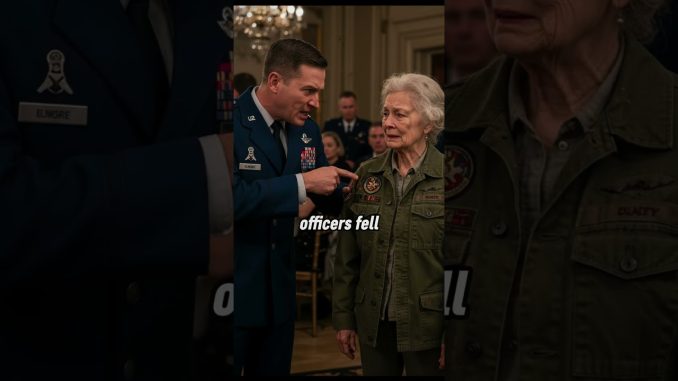
The Officers Club at Andrews Air Force Base sparkled under crystal chandeliers. Medals gleamed, uniforms were perfectly pressed, and the air carried an unmistakable sense of pride and ceremony. It was the annual Air Force Gala, one of the year’s most prestigious events, where decorated service members and high-ranking officials gathered to honor achievement, bravery, and leadership.
Into this world of formality and exacting standards stepped Elra Vance, nearly eighty years old. She wore a faded olive-green field jacket over a simple blue dress. The jacket was patched and worn, showing decades of service. Her appearance immediately drew glances — some curious, some skeptical, and a few mocking. To the untrained eye, she didn’t look like someone of rank or distinction.
Lieutenant Colonel Marcus Thorne, known for his sharp tongue and pride in his authority, approached her.
“Ma’am,” he said coldly, “you’re in the wrong place. This event is for distinguished service members.”
Elra met his gaze calmly. “I was invited,” she said quietly.
Thorne smirked. “Invited by who? Look around. That jacket of yours should have been retired decades ago.” Nearby officers chuckled at his condescension.
Elra didn’t respond. She only adjusted her sleeve, her demeanor unshaken. But then Thorne’s eyes fell on a small black patch stitched to her jacket — a square with a silver teardrop. He laughed dismissively. “What’s this? Some old club emblem?”
His mockery stopped cold. Around the room, murmurs began to ripple. Officers exchanged looks of sudden recognition. One Sergeant Major’s eyes widened in shock. Another officer paled.
At that moment, General Marcus Hawthorne, the evening’s host, approached. His gaze landed on the patch, and the room fell silent. The four-star general’s expression changed immediately. With trembling hands, he snapped a sharp salute and whispered, voice heavy with emotion, “Colonel… you have no idea who you insulted.”
The general turned to the audience, explaining, “That patch represents Sorrow 6 — the last surviving member of a covert unit that carried out missions no one expected to survive. This woman saved countless lives, and many here owe her everything.”
The room was silent. The laughter, the whispers, the mockery — all vanished. Thorne’s confident demeanor crumbled as he realized the gravity of his mistake.
General Hawthorne stepped closer to Elra. “Welcome home, ma’am,” he said softly.
As Elra moved forward, every officer in the room rose to their feet — not because they were instructed, but because honor, courage, and true service had just entered. The gala’s atmosphere transformed from casual admiration to deep respect, reminding everyone present that heroism is not always visible at first glance.
In that moment, it was clear: true honor is not measured by polished appearances, medals, or ceremony. True honor endures, quietly, often unnoticed, until it reveals itself in its full weight.
Elra Vance’s presence reminded every person in the room that courage and service leave marks that time cannot erase — and that respect must always be earned, not assumed.