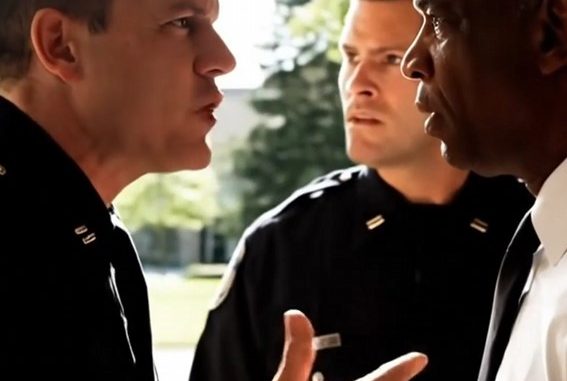
It was a bright, sunny afternoon in a quiet suburban neighborhood when Judge Terren Miles returned home after a long day in court. Wearing a dress shirt and slacks, the well-respected judge stepped outside to pick up a small package left on his porch. What should have been an ordinary moment quickly escalated into a situation that would leave the entire community stunned.
Two police officers, responding to a report from a neighbor who didn’t recognize who lived at the home, rushed toward Judge Miles with urgency. They had been told that a “suspicious man” was trying to enter the property. Without asking for identification, without calmly assessing the situation, the officers confronted the judge immediately.
“Step away from the door!” one of them shouted as the other moved closer. Judge Miles, startled but composed, tried to understand what was happening. The officers insisted he follow their commands, believing they had caught someone attempting to break in.
Judge Miles attempted to explain, telling them clearly that he lived there. But adrenaline and assumption overpowered the moment. Before he could clarify, the officers grabbed him, turned him around, and placed him in handcuffs against his own front door.
“You’re making a serious mistake,” Judge Miles told them firmly. “You don’t know who I am. I can fire all of you.”
Despite his warnings, the officers continued. They assumed he was bluffing, convinced they were dealing with a suspect trying to talk his way out of a situation.
As the commotion continued, neighbors came outside to see what was going on. Among them was a woman who recognized Judge Miles immediately. She approached the officers urgently and said, “He DOES live here! That’s Judge Miles! I saw him on the local news last week.”
Her words caused an immediate shift in the tone of the interaction. The younger officer hesitated, uncertainty replacing his earlier confidence. One of the officers quickly pulled out a phone and looked up Judge Miles’ name in an online database. There, on the screen, was the judge’s official courthouse photo—clear proof of his identity.
Realization struck both officers at once.
Officer 1 uncuffed Judge Miles immediately. The tense energy on the porch shifted into awkward silence. Apologies came quickly, but Judge Miles did not raise his voice or react with anger. Instead, he looked both officers directly in the eyes.
“This,” he said calmly, “is exactly what bias looks like.”
His words were not shouted. They were delivered quietly, but they carried the weight of experience and truth. The officers looked down, fully grasping the gravity of the situation.
Word of the incident spread quickly through the neighborhood and eventually reached local media. Residents questioned how quickly assumptions had been made and how easily a respected member of the community had been treated like a suspect in his own home. Discussions about training, awareness, and communication began almost immediately.
Judge Miles later delivered a thoughtful statement emphasizing the importance of fairness and the need for improved understanding within communities. “Everyone deserves to be treated with respect in their own home,” he said. “Moments like this remind us how important it is to look beyond assumptions.”
The incident served as a powerful reminder: sometimes the smallest moments can reveal the biggest lessons about responsibility, communication, and the importance of not judging others too quickly.