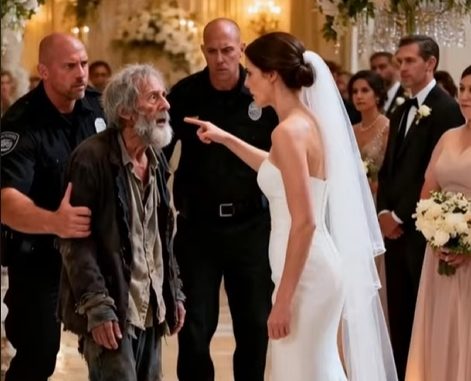
The wedding hall was filled with soft music, white flowers, and quiet excitement. Guests adjusted their seats, cameras were ready, and all eyes turned toward the aisle. It was supposed to be the happiest day of Emma Clark’s life.
Then everything changed.
A frail, poorly dressed elderly man stepped inside the hall, his shoes worn, his posture unsteady. Murmurs rippled through the crowd as he moved closer to the front. Before anyone could fully understand what was happening, a sharp voice cut through the room.
“Security, please get this man out of here. He’s ruining my wedding.”
Guards immediately approached the old man. As they took his arms, he spoke in a trembling but gentle voice.
“Sweetheart… please. I’m your father. Let me just hug you once.”
The bride turned, disbelief written across her face. Her voice was firm, almost cold.
“You’re lying. My father left me a long time ago.”
Some guests whispered. A few exchanged uncomfortable looks. Others laughed nervously, assuming it was an unfortunate interruption. What no one realized was that the man standing before them had been carrying a painful truth for decades—one that was about to change everything Emma believed about her life.
Emma was 28 years old, strong, independent, and proud of how far she had come on her own. As a child, life had not been easy. Her father worked endlessly, taking any job he could find. Her mother spent years in a hospital bed, dependent on machines that kept her alive while medical bills piled up faster than hope.
When her mother passed away one cold winter night, everything collapsed. Savings disappeared. Debts remained. Her father did not disappear into comfort—he disappeared into work. Factories, warehouses, construction sites—anywhere that paid, he went. He came home exhausted, quiet, and distant.
One evening, Emma found an old pocket watch in his bag. It was heavy, scratched, and seemed unimportant. Curious, she tried to fix it herself and accidentally broke it. When her father saw the watch, he froze. His reaction shocked her. He raised his voice, saying she had destroyed everything. It was the only time she had ever seen him lose control.
That night, Emma cried herself to sleep. Her father stood silently outside her door for a long time, unable to bring himself to explain.
A few days later, he was gone.
No note. No goodbye.
Years passed. Emma grew up believing one painful thing: that her father chose work over her. That belief followed her all the way to the altar.
Now, on her wedding day, as security dragged the old man away, he shouted with all the strength he had left.
“Emma, it’s me. I’m your father.”
She shook her head. “My father has been gone for years.”
Then something slipped from the man’s pocket and fell to the floor.
A letter.
Emma picked it up slowly. The envelope read: My Dearest Daughter.
Her hands trembled as she read.
The letter explained everything. The pocket watch she had broken wasn’t his. It belonged to his employer—a rare collector’s item worth more than he could ever repay. To cover her mother’s treatment, he had given away everything he owned. When the truth came out, he went to prison for ten years.
“I never blamed you,” the letter said. “I left because I couldn’t forgive myself. Every choice I made was for you and your mother. If I had to do it again, I would.”
Tears streamed down Emma’s face. She collapsed to her knees, her wedding dress soaked with emotion, not regret.
She ran to the man everyone had dismissed. She held his hands tightly.
“I’ve been waiting for you,” she cried. “I just didn’t know the truth.”
She looked at him and whispered, “Dad… please walk me down the aisle.”
That day, the man many had judged by his appearance became the proudest father in the room.
Because not every absence is abandonment.
Some are silent sacrifices.
If this story touched you, hug your parents while you still can.