In a time when social connections often feel strained and people pass one another without a second glance, moments that reveal our shared humanity stand out powerfully. A recently shared video has captured widespread attention online—not because of shock value alone, but because of the deeper lesson it offers about empathy, accountability, and the importance of standing up for those who cannot easily defend themselves. More than a viral moment, the video serves as a reflection of the choices we make when faced with injustice.
A Moment That Exposed Cruelty
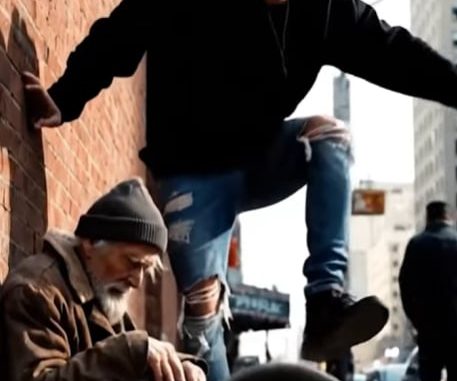
The video opens on a quiet city street. An elderly man sits against a worn brick wall, his posture tired but composed. In front of him rests a small bowl containing a handful of coins—modest contributions from passersby meant to help him survive another day. He is not asking loudly, nor interfering with anyone. He is simply existing.
Suddenly, the calm is disrupted. A younger man approaches with an air of arrogance, clearly seeking attention rather than resolution. Without warning, he kicks the bowl, sending the coins scattering across the pavement. Laughter follows. It is not just the physical act that wounds, but the intention behind it. In a single moment, the elderly man’s dignity is challenged, his vulnerability exposed.
The camera lingers on the older man’s face as he slowly gathers himself. His expression carries more than sadness—it reflects the exhaustion of someone who has endured too many such moments in silence. This scene resonates because it mirrors situations many people have witnessed in real life, moments when someone weaker is treated as invisible or unworthy.
When a Witness Chooses to Act
What transforms this moment from painful to meaningful is what happens next. A nearby observer, seated in a parked vehicle, has seen everything. Like many others might, he could have looked away. Silence would have been the easiest option. Instead, he chooses to act.
The man steps out of his vehicle and calmly confronts the young offender. While his presence is firm and commanding, his goal is not chaos or harm. It is accountability. He represents what many refer to as moral courage—the willingness to intervene peacefully but decisively when something is wrong.
This moment highlights an important truth: standing up for someone does not require anger or aggression. It requires clarity, confidence, and the belief that everyone deserves respect. The intervening man becomes a voice for the elderly individual who had been denied one moments earlier.
Accountability That Teaches, Not Destroys
Rather than escalating the situation, the intervenor chooses a path that restores balance. He instructs the young man to return and make amends. The request is simple but powerful: take responsibility for your actions.
The young man is asked to give what he has to the person he humiliated. This act reverses the imbalance created earlier. It acknowledges harm, offers restitution, and delivers a lesson that words alone often fail to teach. The elderly man receives not just financial help, but something equally important—recognition of his worth.
As the situation resolves, the mood shifts. Tension gives way to relief. The elderly man’s expression softens, and a smile appears. It is a reminder that kindness, especially when paired with justice, can heal more than we realize.
The Broader Message
This video resonates across cultures because it reflects a universal desire for fairness. While not everyone will encounter such a dramatic situation, most people will face moments where they must choose between comfort and conscience.
Standing up for others does not always look the same. Sometimes it means speaking out. Sometimes it means offering support after harm has been done. Sometimes it means refusing to ignore behavior that degrades another person.
A Reflection on Character
At its core, this story is not about punishment or confrontation. It is about character. It asks viewers to consider who they are when faced with injustice—and who they want to be.
Cruelty often comes from insecurity, while compassion comes from strength. The individual who chose to intervene reminds us that real power is not found in dominance, but in protection and empathy. As the video ends, viewers are left with a simple but lasting message: hope can be restored, dignity can be defended, and every person has the capacity to make a difference.
In a disconnected world, choosing humanity is the strongest action of all.