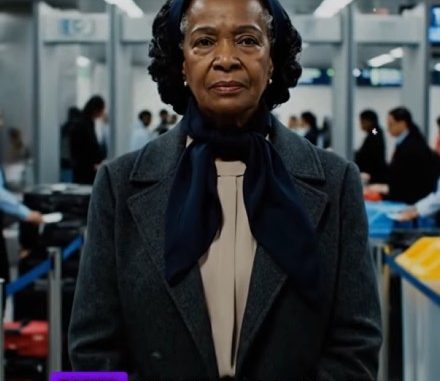
Airports are designed for efficiency, but they often reveal something deeper about human behavior. Lines are long, patience is thin, and assumptions can surface in moments of stress. For Evelyn Brooks, a quiet morning at Atlanta’s Hartsfield-Jackson International Airport became an unexpected reminder of how quickly dignity can be tested—and how powerful calm can be in response.
Evelyn was 68 years old, traveling alone as she had many times before. Her silver curls were wrapped in a simple scarf, the kind she favored when moving through busy places without drawing attention. She held her boarding pass steadily, though her hands felt heavier than usual. Not from fear, but from a lifetime of understanding when to speak—and when silence carried more strength.
As she approached the security checkpoint, a TSA agent spoke sharply, loud enough for others nearby to hear. His tone was impatient, his instructions abrupt. He moved her carry-on onto the inspection table with unnecessary force, unzipping it quickly and without explanation. Around them, murmurs began. A man nearby scoffed. Someone behind whispered an unkind assumption. The moment grew uncomfortable, not because of what was happening—but because of how normal it felt.
Evelyn did not raise her voice. She did not argue. Instead, she took a slow, measured breath. It was the kind of pause learned over decades—one rooted in self-control and self-respect.
The agent removed her belongings one by one: folded clothes, medication, a small framed photo, and finally, a worn leather notebook filled with handwritten notes. He flipped through it carelessly and asked dismissive questions, drawing more attention from the line. Phones lifted. Eyes fixed on the scene.
A supervisor soon approached, clearly ready to end what she assumed was a routine delay. But her expression changed when she noticed the notebook. She leaned closer, reading the name written inside the cover. Her posture shifted immediately.
In a noticeably different tone, she asked Evelyn a quiet question. Evelyn nodded once in response.
The atmosphere changed.
Evelyn Brooks was not simply a traveler. She was a retired federal judge with more than three decades on the bench. Over the course of her career, she had presided over major civil rights cases and later contributed to advisory work on airport security practices—particularly those addressing fairness and bias. The notebook was not a “plan,” as someone had suggested. It was a collection of reflections from a life devoted to the law.
Whispers spread through the crowd, this time with respect. The supervisor apologized promptly. The agent was discreetly pulled aside as procedures were reviewed. Evelyn’s belongings were carefully repacked, this time with gentler hands and lowered eyes.
As Evelyn walked toward her gate, a young woman caught up to her and quietly said thank you—for staying composed, for standing firm without confrontation. Evelyn smiled softly.
“I didn’t survive this long to shrink,” she replied.
Before boarding, she paused and offered one final thought, calm but unshakable: composure is not weakness. Some people carry their strength quietly—until a moment demands it be seen.
Stories like Evelyn’s remind us that dignity doesn’t always announce itself. Sometimes, it simply stands still until the truth speaks for itself.
More stories about resilience, grace, and quiet strength are on the way.