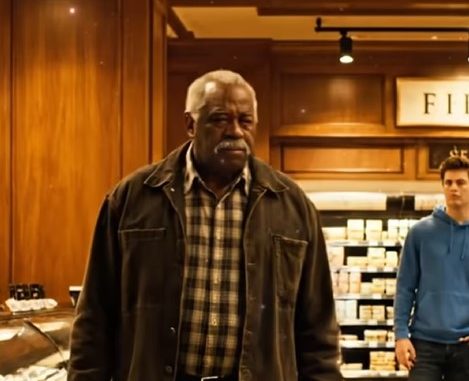
The grocery store was the kind of place designed to feel exclusive without ever saying the word out loud. Polished wooden shelves lined the aisles, soft jazz floated through the air, and every label on every product quietly suggested that if you were shopping here, you belonged. It was a high-end neighborhood market in a wealthy suburb outside Columbus, Ohio—carefully curated and immaculately clean.
On an otherwise ordinary afternoon, Harold Johnson stood in aisle three holding a loaf of artisan bread and a bottle of olive oil. At sixty-eight years old, he moved with calm assurance. His gray hair was neatly trimmed, his posture steady, his work jacket worn but clean—an honest garment that carried decades of early mornings and long days. Harold was not browsing aimlessly. He knew exactly what he needed.
Yet before he could make his way to the checkout, the atmosphere around him shifted.
A cashier glanced up and frowned. A shopper behind him clutched her purse a little tighter. Quiet looks passed between employees—looks Harold had seen before. They were not looks of curiosity. They were looks of assumption.
Harold had lived long enough to recognize the moment when a person is judged before they ever speak.
Soon, the store manager approached. His name was Mark, and his tone was loud enough to carry beyond the aisle.
“Sir,” he said, stepping into Harold’s path, “we’ve had theft problems. I’m going to need to check your bag.”
Harold remained calm. “I haven’t checked out yet,” he replied evenly.
Mark smirked. “That’s usually how it starts.”
A few shoppers slowed down. Someone lifted a phone. No one intervened.
“I’m not a thief,” Harold said. “I’m here to buy groceries.”
Instead of backing down, the manager laughed. “Then act like you belong here.”
That word—belong—landed harder than the accusation itself.
Harold had marched for fair housing in the 1970s. He had watched friends work themselves into exhaustion for opportunities others received effortlessly. He had spent a lifetime building skills, businesses, and communities, often without recognition. He understood exactly what that word implied.
Slowly, Harold reached into his jacket. Security stiffened. A hush fell over the aisle.
But Harold did not pull out anything threatening. He pulled out a business card, its edges softened by time.
“I wired the electrical systems for this entire shopping plaza,” he said calmly. “Back in 1981. Before this store even existed.”
Mark scoffed. “Yeah, okay.”
Before the situation could escalate further, a woman near the produce section stepped forward, visibly shaken.
“Wait,” she said. “Mr. Johnson?”
Harold looked up.
“My father apprenticed under you,” she continued. “You trained him. Because of you, he started his own business. You changed our lives.”
The air in the store shifted. Phones lowered. Whispers stopped. Faces softened as understanding replaced suspicion.
Mark’s confident expression collapsed.
“I didn’t see a man,” Harold said quietly, looking around the store. “You saw a stereotype.”
The woman pulled out her phone. “I’m calling corporate,” she said firmly.
By that evening, video clips of the incident had spread online. The story wasn’t framed as outrage for outrage’s sake, but as a clear reminder of how easily dignity can be dismissed—and how powerful truth can be when it speaks calmly.
Within a week, the store manager was dismissed following an internal review.
Harold still shops at that store today. Not to prove a point. Not to seek validation. But to remind everyone—quietly—that dignity does not come from permission or approval.
It comes from truth.
From history.
From standing tall when the world tries to shrink you.
And sometimes, it only takes one moment in aisle three for people to finally see what was always there.