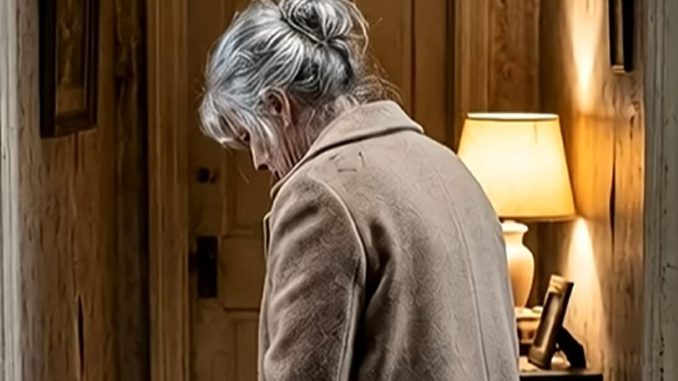
The elderly woman stood frozen at the front door, a grocery bag weighing down her arm. Inside that bag were a few basic necessities—bread, milk, fruit—but the real weight pressed on her chest. The house behind her, once filled with warmth and family laughter, now felt colder than the winter air outside.
The argument had unfolded quickly, but the words lingered painfully.
“It’s her or me,” her daughter-in-law had said sharply, her voice slicing through the room. “She’s a burden. I can’t live like this anymore.”
The son stood there, torn between loyalty and fear. He muttered something about family, about patience, but his words lacked strength. Before he could finish, his wife interrupted him, firm and final.
“If she doesn’t leave tonight, I will.”
The elderly woman didn’t wait to hear the rest. She already knew the answer. Years of experience had taught her how silence can be louder than words, and how weakness often hides behind avoidance. Without raising her voice, she gently set the grocery bag down.
She walked to her small room and packed what little she owned into a worn suitcase—a sweater, a photograph, a few letters saved from better times. Her entire life, reduced to something she could carry with one hand.
As she passed through the living room, she paused. Her voice was barely a whisper.
“I won’t trouble you anymore.”
The daughter-in-law looked away, a faint expression of satisfaction crossing her face. The son stared at the floor, unable to meet his mother’s eyes. Moments later, the door closed with a quiet but final sound.
Outside, the wind cut sharply against her face. She had nowhere to go, no savings, no plan—only the clothes she wore and the dignity she refused to lose.
She hadn’t walked far when hurried footsteps echoed behind her.
“Grandma, wait!”
She turned to see her granddaughter running toward her, breathless, without even a coat. The girl’s hair was undone, her face flushed from the cold and from something deeper—emotion.
The grandmother tried to stop her. “Go back,” she pleaded softly. “You have a home there.”
The girl shook her head and took her grandmother’s cold hand, gripping it tightly.
“I don’t have a home where kindness doesn’t exist,” she said, her voice trembling—not from the weather, but from conviction.
Then the girl reached into her pocket and pulled out a small, crumpled piece of pink paper.
“Mom was too busy arguing to notice what was on the fridge,” she added gently.
The elderly woman stared at it, confused at first—then stunned. It was the lottery ticket she had bought the day before, taped to the refrigerator with a magnet and almost forgotten.
“I checked it this morning,” the girl said, smiling through tears. “Grandma… it won.”
Under the glow of a streetlight, the truth settled in. The ticket wasn’t just a prize—it was a turning point. A moment that transformed rejection into freedom.
“Let them keep the house,” the girl said softly. “We’re going to build a life filled with peace.”
They called a taxi and headed toward a new beginning, leaving behind a place that had lost its warmth long before they did.
As the car disappeared down the street, the granddaughter leaned close and whispered, “Some people don’t realize the value of what they have until it’s gone.”
That night, a lesson was quietly written: kindness is never a burden, and love—when dismissed—has a way of returning stronger than anyone expects.
Sometimes, the greatest wealth isn’t found in money, but in knowing who chose compassion when it mattered most.