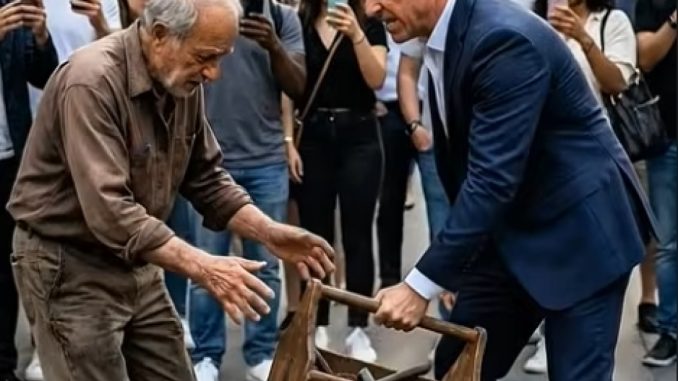
In the shadow of a luxury mall where glass storefronts reflected wealth and excess, an elderly shoe repairman worked quietly on the sidewalk. His stall was simple—an old wooden basket, worn tools, and a broken stool that creaked each time he sat down. With trembling fingers shaped by decades of labor, he restored leather shoes by hand, charging just twenty-five dollars for hours of careful work.
That afternoon, the calm was shattered when a sharply dressed man slammed the wooden basket onto the pavement.
“Are you insane?” the man shouted. “You expect me to pay this much?”
Pedestrians slowed. Phones came out. Someone whispered that it was just another greedy street seller trying to overcharge. The repairman lowered his head, his voice barely rising above the noise of the street.
“Sir, please… these shoes take hours to fix by hand.”
The man laughed. “You people always overvalue your misery.” He scoffed, tossed five dollars onto the ground, and walked away toward the luxury mall, leaving silence behind him.
Inside, the same man spent hundreds without blinking—complaining about service, ordering expensive desserts, and leaving a generous tip, not out of kindness, but to feel powerful. Outside, the repairman remained seated, quietly gathering his tools.
A short while later, a young woman stopped at the stall. She held out a pair of worn shoes and asked the price.
“Twenty-five dollars, miss.”
She frowned. “I’ll give you ten. You people don’t know your place.”
When the repairman gently refused, she walked into a nearby chain store and purchased cheap plastic shoes for forty dollars, smiling as if she had made a clever deal. The repairman said nothing. His stomach growled as the evening lights flickered on.
Then, a quiet man approached.
He looked tired, his shoulders slumped not from age, but from grief. His voice was soft.
“My wife passed away last month,” he said. “I worked two jobs, but life has been heavy. These are the only shoes I own. I have twenty dollars.”
The repairman studied the worn shoes, then looked into the man’s eyes. After a moment, he smiled gently.
“Please,” he said, pushing the shoes back toward him. “Keep your money. Take the shoes. You deserve to walk with dignity.”
The man froze.
“I can’t accept this,” he whispered. “You need this more than I do.”
He walked a few steps away, then stopped. Slowly, he turned back. From his wallet, he took out two hundred dollars and placed it into the repairman’s hands.
“You didn’t see me as a poor customer,” the man said quietly. “You saw me as a human being who deserved respect.”
The repairman’s hands trembled. Tears streamed down his face as the crowd stood in silence, phones forgotten. The man added one final thought before leaving.
“True empathy isn’t about bargaining with the weak. It’s about lifting them when you can.”
In a world where value is often measured by appearance, status, or price tags, this quiet moment reminded everyone watching of a deeper truth. Kindness costs nothing, but it can change everything. Sometimes, the greatest wealth isn’t found inside luxury malls—but on a sidewalk, shared between two people who choose dignity over pride.