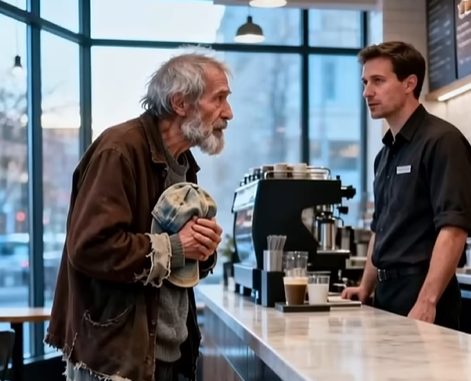
It was just after sunrise when the City Light Café opened its doors to the early rush. Coffee machines hummed, chairs scraped softly across the floor, and the smell of fresh bread filled the room. That morning, most customers were focused on their phones, their schedules, and their own worries. No one noticed the old man at first.
He stood quietly near the counter, his clothes worn and his cap clenched tightly between trembling hands. His voice was barely audible when he finally spoke.
“Sir, could you spare a little food? Even some leftover bread. I’m really hungry.”
The café manager didn’t hesitate. He rolled his eyes, irritation written clearly across his face.
“This is a café, not a shelter,” he snapped. “If you want to eat, go get a job.”
The old man lowered his head. “I really don’t have anywhere else to go,” he said softly.
That was enough for the manager. Losing patience, he grabbed the man by the collar and shoved him toward the door. “Get lost,” he barked. “You’re going to scare away customers.”
A few people snickered. Someone lifted their phone to record. The old man whispered an apology and staggered out onto the street, his dignity left behind on the café floor.
A few blocks away, inside a small convenience store on Oak Street, the atmosphere was very different. Behind the counter, a young woman named Aaron Walker was stocking shelves. Her apron was plain, her movements quiet, but her expression was focused and calm.
When the same old man stumbled into the store, his stomach growling loudly, another clerk frowned.
“No begging in here,” the clerk said sharply. “You need to leave.”
Before the man could even speak, Aaron stepped forward.
“Wait,” she said gently. “He hasn’t even said anything yet.”
She turned to the old man, lowering her voice. “Are you okay? Do you need something?”
The man hesitated, embarrassed. “I was just hoping for a little food,” he admitted.
From the back of the store, the manager called out, “Aaron, we’re not a charity.”
Aaron paused for a moment, took a deep breath, and made a decision that would stay with her forever.
“Then take it out of my paycheck,” she replied. “This meal is on me.”
She pulled out her wallet, packed a warm meal with her own hands, poured a cup of milk, and invited the old man to sit at a small table in the corner. He ate slowly, carefully, like someone who hadn’t felt safe enough to enjoy a real meal in a long time.
“Thank you,” he said quietly.
“It’s okay,” Aaron replied. “I know what hunger feels like. My family struggled when I was young. I worked every job I could to get here. I can’t pretend I don’t see people who are hurting.”
The old man studied her for a long moment. Then he spoke her full name.
“Aaron Walker.”
She froze. “I never told you my name.”
The man smiled gently and spoke in a way that felt less like accusation and more like memory. He spoke of moments from her childhood—times of hardship, quiet kindness, and strength she had almost forgotten. As he spoke, tears rolled silently down her face.
“Who are you?” she whispered.
In that moment, the store felt unusually still. The scene wasn’t loud or dramatic, but deeply personal. To Aaron, it felt as though something greater than coincidence was taking place—like a reminder, not of judgment, but of purpose.
When she looked again, the chair across from her was empty. The food remained warm, untouched now. Nothing else had changed, and yet everything felt different.
Aaron stood there, her heart calmer than it had ever been.
Some moments don’t come to impress us. They come to test us.
Because sometimes, the true measure of who we are isn’t how we treat people who can give us something back—but how we treat those who can’t.
If you met someone like that old man one day, what would you do?
Let me know your thoughts in the comments.