In a world increasingly driven by appearances, status, and material success, it is easy for some people to forget the most basic human value: respect. A recent short-form story circulating online has captured widespread attention, not because of extravagance or glamour, but because it delivers a timeless lesson about humility, empathy, and accountability.
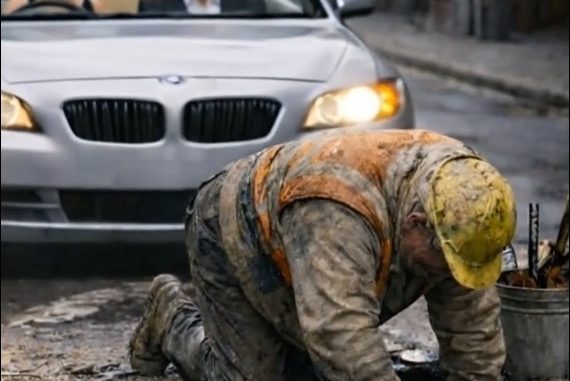
The story opens on an ordinary city street, where a sanitation worker is doing one of the most difficult and least appreciated jobs in urban life. Covered in protective gear and working below ground, he represents millions of people whose labor keeps society functioning smoothly. As fate would have it, a luxury convertible speeds past the open manhole. Instead of slowing down or showing concern, the passengers laugh as dirty water splashes onto the worker, turning a hard day’s work into a humiliating moment.
To the couple in the car, it was nothing more than a joke. They laughed loudly, mocking the worker and treating his discomfort as entertainment. In that brief moment, the power imbalance was clear: wealth on one side, honest labor on the other. What they failed to realize was that their behavior revealed far more about their character than about the man they were mocking.
Moments later, the situation begins to change. Traffic ahead suddenly comes to a halt as larger vehicles block the road. The carefree laughter fades into confusion and discomfort. The couple, who moments earlier felt untouchable, now finds themselves forced to stop and face an unexpected confrontation. The shift is not just physical but symbolic—an abrupt reminder that no one is above consequences.
A calm but authoritative figure approaches and asks a simple question: is it still funny? That question carries more weight than anger ever could. It forces reflection, something arrogance rarely allows. The mood changes completely. The laughter disappears, replaced by silence and fear. The couple is confronted not with violence, but with the reality of their own behavior.
The story reaches its peak when the same filth that was once used to humiliate a worker is returned to the source of the mockery. The luxury car, once a symbol of status and pride, becomes meaningless when covered in trash. The message is clear and powerful: material possessions do not define worth, and disrespect often finds its way back to the one who gives it.
What follows is not about destruction, but about loss of dignity. The couple, now stripped of their confidence, sits in shock and regret. The expensive car, once a tool for showing off, is irrelevant. What remains is the emotional weight of public embarrassment and the realization that kindness costs nothing, but cruelty can be very expensive.
The final scene leaves a lasting impression. The worker, though not seeking revenge, is indirectly vindicated. The couple is left with a lesson that no amount of money can erase: respect is not something you buy, but something you earn through how you treat others, especially those society often overlooks.
This story resonates because it reflects real life. Every day, people are judged by their jobs, clothes, or social standing. Yet history and experience repeatedly show that arrogance is fragile, while humility endures. The true measure of character is not how we treat those who can benefit us, but how we treat those who cannot.
In the end, the story serves as a reminder to pause before laughing at someone else’s misfortune. Life has a way of balancing the scales, often when we least expect it. Respect, empathy, and humility are not just moral ideals—they are safeguards against becoming the very lesson others learn from.