After finishing a long evening shift at the restaurant, the waitress gathered her things and stepped outside, ready to head home. The street was quiet, lit by soft yellow lamps and the distant hum of passing cars. As she walked, something caught her attention that made her slow down.
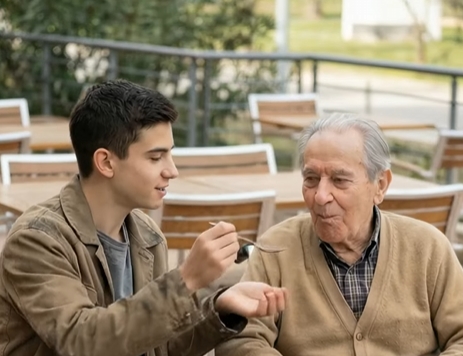
Across the sidewalk, a young man was kneeling beside an elderly man with a visible physical impairment. The young man gently offered him food, speaking softly, making sure the man could eat comfortably. There was no camera, no audience, no expectation of praise—just a simple act of care.
The waitress stood still, deeply moved by what she was witnessing. In a world that often rushed past suffering, this young man had chosen to stop.
When she finally approached to thank him, the young man looked up, startled. The moment their eyes met, he stood quickly and ran away.
“Hey! Please wait!” the waitress called out, surprised and confused. She tried to follow him, but he was already disappearing down the street.
As she slowed her steps, she noticed something lying on the ground. It was a folded letter that had slipped from the young man’s pocket while he was running. Curious and concerned, she picked it up.
Later that night, she opened the letter.
It wasn’t just a note—it was a memoir.
In it, the young man wrote about how he had spent his life helping others. He described showing up whenever someone needed support, offering kindness without expecting anything in return. But again and again, he wrote, those same people had hurt him, dismissed him, or taken advantage of his generosity. The words were raw, honest, and full of quiet pain.
By the time she finished reading, the waitress had tears in her eyes.
The next day, while running errands, she saw him again—this time in a small grocery store. He was standing near the checkout, hugging a middle-aged mother who was visibly emotional. The cashier smiled as the woman thanked the young man for paying for her groceries.
She explained that she hadn’t earned enough that month to feed her children.
The waitress hurried over.
When the young man noticed her, his body tensed. He stepped backward, fear filling his face.
“Please don’t hurt me,” he said nervously. “I was just trying to help that elderly man.”
The waitress immediately reassured him. She told him she wasn’t angry, wasn’t there to judge, and wasn’t going to tell him to leave. She explained how deeply she appreciated his kindness and how moved she was by what she had seen.
Then she handed him the letter.
“You dropped this yesterday,” she said gently. “I’ve been looking for you so I could return it.”
The young man’s hands trembled as he took it. Tears welled in his eyes.
“So… you read it?” he asked.
She nodded. “Yes. And I cried. You’re hurting because people don’t value your kindness. You give so much, but you’re rarely given the same in return.”
At that moment, the young man broke down. He slid down against the wall, overwhelmed. The waitress sat beside him, offering comfort without pressure.
He finally admitted the truth.
“I run away because people criticize me for being kind,” he said. “Whenever I let someone get close, I end up getting hurt. I thought you were going to tell me to go away, so I ran.”
He also shared that he had recently lost his job and had been forced to leave his mother’s home. Despite having very little left, he still chose to help others—including paying for that mother’s groceries.
The waitress listened carefully, speaking to him with respect and warmth—words he said no one had ever spoken to him before.
“Even if others don’t appreciate your kindness,” she told him, “I do. You keep helping people even when you’ve been hurt. That doesn’t make you weak. It makes you incredibly strong.”
For the first time in a long while, the young man smiled.
“Thank you,” he said quietly. “You’re the only one who truly understands me. You make me feel seen.”
From that day on, the waitress made sure he was never turned away from her restaurant. She let him eat for free when he needed to and welcomed him into her family’s home so he could feel safe, valued, and appreciated.
Sometimes, a single act of understanding can change a life.
And sometimes, all it takes is one person to recognize someone’s worth and help them rise again.
If you believe kindness deserves recognition, drop a heart.