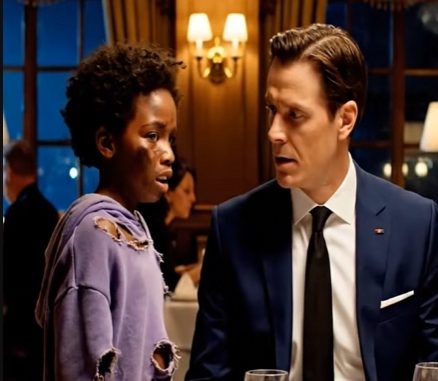
The restaurant was quiet in the way expensive places often are. Soft music played in the background, glasses clinked gently, and conversations stayed low and controlled. At one corner table, Richard Sterling sat finishing his meal, surrounded by polished surfaces and unspoken rules about who belonged and who did not.
That illusion shattered when a small voice spoke near the table.
“Sir… can I have your leftovers?”
The words were barely audible, but the tension they created was immediate. A young boy stood a few steps away, thin jacket pulled tightly around him, eyes fixed on the table. Before anyone else could react, the restaurant manager rushed forward, face tight with anger.
“This is private property. You need to leave now,” the manager snapped. “If you don’t, I’ll call the police.”
Every nearby diner froze. Everyone expected the same thing—to watch, then look away. To pretend nothing had happened. To let the moment disappear.
Richard did not.
Instead, he stood up.
Slowly, deliberately, he pulled out the empty chair beside him and looked at the boy.
“Sit down, son,” he said calmly.
The manager’s face flushed red. “Mr. Sterling, this is highly inappropriate,” he protested.
“I’ll decide what’s appropriate at my table,” Richard replied, cutting him off. He turned back to the manager. “Bring him the full Christmas menu. Everything.”
The boy hesitated, hands trembling, before sitting down. Richard leaned closer, lowering his voice.
“What’s your name?”
“Jamal, sir,” the boy answered. His voice cracked as tears formed. “My dad works two jobs. Night shifts. He forgot to buy food. I didn’t want to bother him because… because he cries every night since my mom died.”
The table fell silent.
One of Richard’s business clients stood abruptly, tossing his napkin down. “This is unprofessional,” the man said coldly. “We’ll take our business elsewhere.”
He walked out, ending a deal rumored to be worth over twenty million dollars.
By the next morning, the moment was everywhere. Someone had filmed it and posted it online. The video spread fast, stripped of context and full of harsh assumptions. Headlines accused Richard of staging a publicity stunt. Comment sections were unforgiving.
The backlash came quickly.
His business partner called, furious. “You just cost us our biggest client. What were you thinking?”
Then his ex-wife called, her voice sharp with old wounds. “You’re doing that guilt thing again,” she said. “Stop trying to replace our son.”
Richard said nothing.
Instead, he asked Jamal for his address.
He drove the boy home himself.
As the car slowed in front of a worn apartment building, Richard felt a strange sense of familiarity. He checked the address on his phone, and his stomach dropped.
This was the building.
The one his company planned to demolish next month. A luxury development was already designed—forty stories, massive profits, a symbol of success.
The door opened, and Jamal’s father stepped out.
Marcus.
Richard recognized the name instantly from legal files. Marcus was the only resident refusing to sell. The one suing to stop the eviction.
Marcus’s expression hardened when he saw Richard. “Get away from my son,” he said, pulling Jamal close.
“I’m sorry,” Richard replied quietly. “I didn’t know. I just wanted to make sure he got home safely.”
The door closed, but not before Richard saw inside.
The apartment was small, but clean. Family photos covered the walls. Smiles, birthdays, memories. Love lived there—quiet, persistent, real.
Richard stood frozen.
He thought of his own son. Six years old. Gone three years earlier in a car accident. Christmas Eve. The same night.
He returned to his house later that evening—twenty rooms, all silent.
The next morning, Richard made a call.
“Cancel the demolition,” he told his lawyer. “We’re not buying the building.”
The board would be furious. His partner would revolt. He didn’t care.
When Marcus asked why, Richard answered simply.
“Because some things are worth more than money,” he said. “I spent three years trying to fill a hole by building higher. A six-year-old showed me I was destroying the only thing that matters.”
Before leaving, Richard knelt in front of Jamal.
“Keep being brave enough to ask for help,” he said. “The world needs more people like you.”
The building still stands.
So does the family inside it.