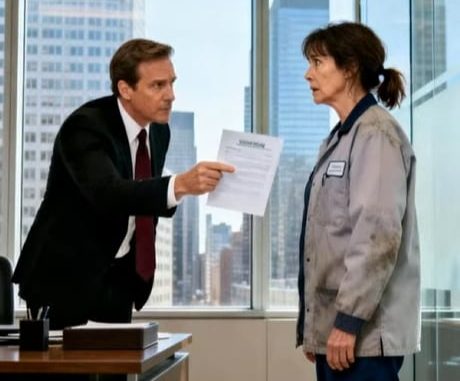
The supervisor slammed the termination letter onto the desk with a sharp, impatient motion. The paper slid slightly before stopping, its finality echoing louder than his words. According to him, there was no room for mistakes—especially not from someone he considered easily replaceable.
Moments earlier, a cup of coffee had spilled onto an important contract, and an antique vase in the executive office lay shattered. To the supervisor, the explanation did not matter. To him, it was simple: a rule had been broken, damage had been done, and someone needed to be blamed.
The woman standing across from him tried to speak, her voice shaking. She explained that the client’s child had slipped near the stairs. Without thinking, she had reached out instinctively to stop the fall. In that split second, the coffee tipped, the vase fell, and everything changed.
The supervisor cut her off. There would be no discussion. No exceptions. She was told to pack her belongings and leave immediately.
Her name was Martha. She was forty-five years old and had worked quietly in the same office tower for a decade. Day after day, she cleaned floors, wiped desks, and emptied trash bins without drawing attention to herself. Most people barely noticed her presence. Few knew her story.
Martha worked not for recognition, but for someone far away—a sick granddaughter living in the countryside. Every paycheck mattered. Every hour of work was a step closer to medical care and hope.
With trembling hands, she gathered her few belongings: an old bag, some folded clothes, and a single photograph. The photo showed a smiling little girl, her reason for enduring long nights and tired mornings.
When Martha stepped outside the building, rain poured from the sky. She had no umbrella and made no effort to shield herself. She walked toward the curb slowly, letting the rain fall freely, as if she no longer had the strength to resist anything.
Before she could take another step, the supervisor rushed after her. He shoved a document toward her, demanding she sign a statement admitting responsibility for the broken vase and agreeing to pay for it. Martha’s hands shook as she looked at the paper, her lips parting to respond.
At that exact moment, a black sedan pulled up beside them.
The door opened, and the company’s CEO stepped out, holding an umbrella. He looked from the soaked woman to the tense supervisor and asked calmly what was happening.
The supervisor immediately straightened, explaining that Martha had caused damage and had already been dismissed. He spoke confidently, certain his actions would be approved.
But the CEO’s expression changed.
His voice grew firm as he asked a simple question: did the supervisor even know who she was?
The CEO turned to Martha, recognition in his eyes. Ten years earlier, his young daughter had slipped on those same stairs. Martha had run forward without hesitation, catching the child before she hit the ground. In doing so, Martha had fallen badly herself, suffering a serious injury.
That day, his daughter was saved because of her.
And today, the CEO realized, Martha had done the same thing again—putting herself at risk to protect a child. The stained contract and broken vase were not signs of carelessness, but proof of compassion.
The CEO looked directly at the supervisor and made his decision. The person who failed to understand the value of human life did not belong in a position of authority.
The supervisor stood frozen as the rain continued to fall.
The CEO then handed Martha a check. It was for two hundred thousand dollars—partly compensation for what she had never been properly thanked for years ago, and partly gratitude for who she continued to be.
Martha tried to refuse. All she wanted, she said softly, was her job—so she could care for her granddaughter.
The CEO gently reminded her that kindness is not a weakness, nor a burden. It is a treasure that returns in ways no one expects.
Standing in the rain, Martha held the photo of her granddaughter close. For the first time in a long while, she smiled—not because of money, but because she knew her compassion had never been wasted.
Kindness, after all, has a way of finding its way back.
If you believe that too, type “kind” in the comments.