The salesman glanced at me, then quickly looked away.
Another checked his phone. One suddenly became very busy rearranging brochures that clearly did not need organizing. A senior manager walked past without slowing down, as if I were part of the furniture.
I stood there for fifteen minutes.
No greeting. No acknowledgment. No offer of help.
Finally, a young salesman approached with a polite smile.
“Good afternoon, sir. Can I help you find something today?”
Before I could answer, the senior manager appeared at his side.
“Jackson, I need you for paperwork,” he said curtly. Then, without looking at me properly, he added, “This gentleman is just browsing.”
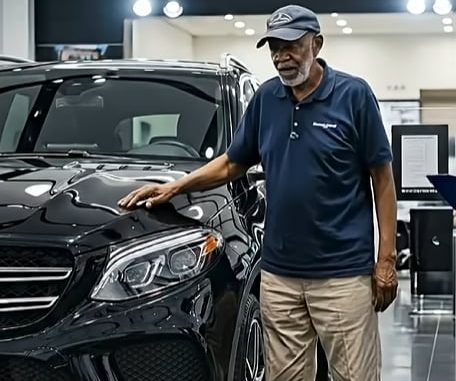
“I’d like to buy that GLE,” I said calmly, pointing to the black one on the showroom floor.
The manager looked me up and down. His smile suggested I had told a joke.
“Sir, that vehicle is ninety thousand dollars,” he said loudly. “Perhaps you’d feel more comfortable at a used car dealership down the street.”
A few customers turned to stare. Someone laughed quietly. A couple of phones were raised, recording. The young salesman shifted uncomfortably but said nothing at first.
What the manager did not know was that he had just insulted someone who owned forty-seven car dealerships across the United States.
My name is Robert Thompson. I am sixty-five years old.
That afternoon, I was dressed plainly: a navy polo shirt, wrinkled khakis, and orthopedic sneakers. I am six foot nine, though years of injuries have left me slightly hunched. I walk with a limp from multiple knee surgeries.
I probably looked like a retired factory worker. Maybe a former athlete whose career never quite took off.
What most people do not know at first glance is that from 1982 to 1997, I played professional basketball for the New York Knicks. I won three championships, made seven All-Star appearances, and was inducted into the Hall of Fame in 2005.
After retirement, I built Thompson Auto Group. Today, we operate forty-seven dealerships with over two billion dollars in annual revenue.
I do not wear designer suits. I value comfort over appearances.
That day, I was there to buy a vehicle for my son’s birthday. I did not announce who I was. I wanted to observe how customers were treated—especially those who did not look wealthy.
The manager stepped closer.
“Sir, I’m trying to save you embarrassment,” he said. “That car requires proof of income and excellent credit.”
“I can pay cash,” I replied.
He laughed. “Right. We’re busy with serious buyers.”
The young salesman, whose name tag read Tyler Jackson, finally spoke.
“I’d like to help this gentleman,” he said respectfully. “It’s my turn for a walk-in.”
“Don’t waste your time,” the manager snapped.
Tyler looked at me. “Sir, would you like to take it for a test drive? I’ll just need your driver’s license.”
I handed it over.
He entered my name into the system. As he typed, an automatic search result appeared on the screen.
His hands froze.
He stared at the monitor, then at me, then back at the screen. His face drained of color.
“Mister Thompson?” he said softly. “As in… the Knicks legend?”
The showroom went silent.
The manager leaned in, confused, until he saw the screen himself. His face turned pale.
I reached into my pocket and placed a business card gently on the desk.
“I came here to buy a car,” I said evenly. “But what I learned today is far more valuable.”
I turned to Tyler. “You treated me with respect when you didn’t know who I was. That matters.”
Then I faced the manager. “How you treat people should never depend on what you assume they can afford.”
I left without purchasing the vehicle.
The following week, Tyler received an offer to join one of my dealerships—where courtesy is not optional, and character matters as much as performance.
Respect costs nothing. But its absence can cost everything.