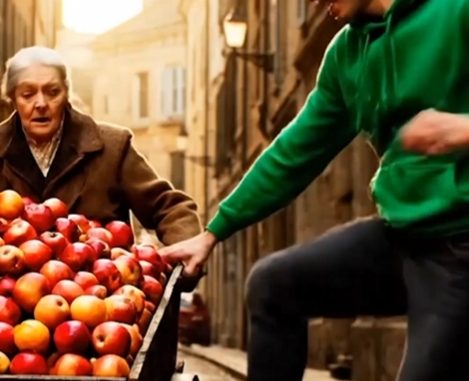
In a world that often feels hurried, distracted, and emotionally distant, moments of everyday cruelty can reveal uncomfortable truths about who we are as individuals and as a society. A recently shared video has captured widespread attention online, not because of spectacle alone, but because it highlights a moral lesson many believe we are in danger of forgetting: how we treat the most vulnerable reflects our true character far more than status, wealth, or appearance ever could.
The Incident That Sparked Outrage
The video opens on a modest cobblestone street under warm afternoon sunlight. An elderly woman slowly moves forward, pushing a small wooden cart filled with apples and oranges. Her pace is unsteady, her posture tired, but her determination is evident. This cart is not a hobby or a casual street display; it represents her livelihood, her independence, and her dignity.
As she carefully navigates the uneven stones, a young man wearing a bright green hoodie approaches. Without warning or provocation, he strikes the cart with his foot. The sudden impact sends the fruit scattering across the ground. Apples roll into the gutter. Oranges bounce against the stone walls. What had taken hours of careful preparation is undone in seconds.
Instead of helping or apologizing, the young man steps back and laughs. The elderly woman drops to her knees, attempting to gather what she can, her hands trembling as passersby freeze in shock. The young man eventually walks away, appearing amused, unaware of the broader consequences his actions are about to trigger.
A Witness Steps Forward
What the young man does not realize is that the moment is not as private as he assumes. Nearby, a well-dressed man standing in a doorway has observed everything. His reaction is not impulsive or aggressive. Instead, it is deliberate. He pulls out his phone, not to confront the young man directly, but to report the incident and ensure it does not go unanswered.
This moment shifts the tone of the video. It moves from cruelty to responsibility, from humiliation to accountability. The witness represents something larger than himself: a reminder that communities function best when people refuse to ignore wrongdoing.
Consequences, Not Revenge
Later in the video, the young man is seen several streets away, sitting on a high-end motorcycle, scrolling through his phone. He appears relaxed, detached, and confident that the earlier incident is already behind him.
What follows is not an act of chaos or unchecked retaliation, but an intervention. Authorities and responsible parties arrive and escort him back to the scene. The emphasis here is not punishment for entertainment, but acknowledgment of harm caused. The young man is confronted with the real-world impact of his behavior: the frightened woman, the damaged cart, and the scattered produce that represented her daily income.
He is required to face the woman directly and take responsibility. The laughter is gone. In its place is visible discomfort and regret. The video ends not with further destruction, but with a clear reversal of power: the person who once mocked vulnerability now stands humbled before it.
Why the Story Resonates
The reason this video has resonated with millions is not because of shock value, but because it speaks to something deeply human: the desire for fairness. Many people go through life feeling that unkindness often goes unpunished, especially when directed at those who lack power or influence. Seeing accountability—even briefly—offers reassurance that decency still matters.
Several important lessons emerge:
Respect for the Elderly
Elderly individuals often represent resilience, history, and sacrifice. Disrespecting them is not just an individual failing, but a social one.
The Myth of Being Unseen
In public spaces, actions carry weight. Whether through witnesses or consequences, behavior rarely exists in isolation.
Accountability as Growth
True learning does not come from humiliation, but from facing the impact of one’s choices and making amends.
A Quiet but Powerful Ending
The video closes with the elderly woman no longer alone. Bystanders help her collect her remaining fruit, and she is visibly reassured by the support around her. While the incident itself is painful to watch, the resolution sends a constructive message: cruelty may be quick, but compassion and accountability last longer.
In a time when negativity spreads easily, this moment serves as a reminder that kindness costs nothing, yet its absence can cost far more than we expect.