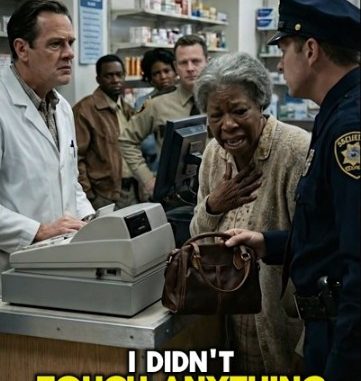
She stood at the pharmacy counter clutching a small, worn purse, her fingers stiff from cold and fatigue. The fluorescent lights above made everything feel harsher than it already was. She counted the bills twice before sliding them forward, her voice barely steady.
“Please wait. This is all I have,” she said quietly. “Please don’t send me back without my medicine.”
The pharmacist sighed and barely looked at her. His tone was sharp and dismissive. He spoke as if he had already made up his mind.
“If you don’t have money, don’t waste our time,” he said. “People are always acting poor just to get sympathy.”
Her shoulders stiffened, but she did not raise her voice. “I’m not begging,” she replied. “I’m surviving.”
That should have been the end of it. Instead, it became something far worse.
A sudden accusation cut through the room. “Hey, open that purse. That’s my money. Thief. I saw you steal.”
The words hit her like a blow. Conversations stopped. A few people turned to watch. Some reached for their phones. Judgment settled in the air without hesitation.
Her eyes filled with tears as she shook her head. “I swear on my children, I didn’t touch anything,” she said. “I’m a mother. I did nothing. I only came here for medicine.”
No one listened.
Security was called. A hand grabbed her arm roughly, and she cried out as pain shot through her wrist. “You’re hurting me,” she said. “I did nothing wrong.”
The response was cold and final. “Tell that to the judge.”
As metal cuffs closed around her wrists, her voice broke. “I raised my children with honesty,” she said through tears. “God is watching.”
The room felt smaller as whispers spread. To many, the situation already seemed settled. She looked tired. She looked poor. That appeared to be enough to decide her guilt.
Moments later, a senior officer entered with a calm authority that changed the atmosphere. He reviewed the situation carefully, checking records and security footage. His expression remained composed as he addressed the room.
“Remove the cuffs,” he said firmly.
There was no missing money. No evidence of theft. No proof of wrongdoing. The accusation collapsed under the weight of facts.
The officer turned to the pharmacist and then to the surrounding staff. “This woman is Mrs. Johnson,” he said. “She is the mother of one of the largest donors supporting healthcare services in this city.”
The shift was immediate and uncomfortable.
Apologies followed quickly. Voices that had been sharp moments before softened into embarrassment and regret. The pharmacist struggled to find the right words. Staff members lowered their eyes.
She stood there silently as the cuffs were removed, her wrists red and aching. She did not demand anything. She did not shout or accuse.
Instead, she spoke with a quiet clarity that carried more weight than anger ever could.
“He did wrong because he didn’t hear me when I was poor,” she said. “You believed me only when my name mattered.”
No one interrupted her.
She collected her medicine, closed her purse, and straightened her coat. With steady steps, she walked out of the pharmacy, leaving behind a room filled with silence and reflection.
What remained was not shame alone, but a lasting reminder of how dignity is too often tied to appearances, and how easily compassion disappears when someone seems powerless.