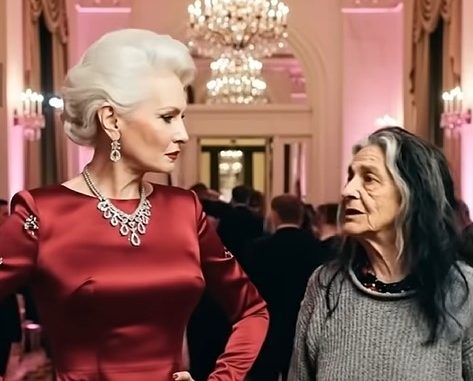
The grand ballroom shimmered under crystal chandeliers. Men in tailored tuxedos adjusted cufflinks while women in elegant evening gowns glided across the marble floor. Soft music filled the air as servers moved carefully between tables, carrying silver trays of champagne. This was not just any event—it was a private charity gala, attended by donors, executives, and community leaders who had gathered to celebrate generosity.
That night, a woman stepped quietly through the entrance.
She wore a torn wool sweater, a faded long skirt, worn sneakers, and carried a ripped canvas bag. Her gray hair was tangled, and her clothes smelled of damp basements and old fabric. To the guests, she looked like someone who had wandered in from the street.
“Good evening, I’m here for the gala tonight,” she said calmly.
The response was immediate and sharp.
“This is a private charity event for donors only,” a staff member snapped. When the woman tried to explain, she was cut off mid-sentence. Security was called. Within moments, whispers rippled through the crowd.
“Is she homeless?”
“How did she get in?”
“Someone get her out before she ruins the evening.”
Phones appeared. People filmed. No one intervened.
The head of security grabbed her arm and pulled her toward the exit. She didn’t struggle. She didn’t raise her voice. She simply looked around the room as people stared, whispered, and recorded.
What none of them knew was that in less than five minutes, the meaning of this entire evening would change.
Her name was Margaret Sullivan. She was 62 years old that night. And everything about her appearance was intentional.
Margaret was the founder of the Sullivan Foundation—the very charity hosting the gala. Over her lifetime, she had donated more than $500 million to support housing, education, and rehabilitation programs for people experiencing homelessness.
That night, she had dressed this way for a reason.
She wanted to know whether the organization she had built truly cared about the people it claimed to serve—or whether compassion ended when the cameras turned off.
As she was being escorted toward the door, the event coordinator, Mrs. Blackwell, approached with a tight smile and a diamond necklace that sparkled under the lights.
“This event is for people who contribute to society,” she said coldly. “Not people who take from it.”
Something inside Margaret went still.
Years of sacrifice, vision, and dedication had created this foundation. And yet the values she believed in were nowhere to be found in that room.
Then, a quiet voice broke the tension.
“Wait. Please.”
A young college-aged volunteer named Sarah stepped forward. She wore a simple vest and nervous determination. She looked at Margaret—not at her clothes, not at her bag, but at her face.
“Ma’am,” Sarah said gently, “are you hungry? There’s food in the back. Let me help you.”
The coordinator snapped back, threatening Sarah with termination. But the young woman didn’t move.
“If we’re here to help homeless people,” Sarah asked, her voice shaking, “why are we throwing one out?”
The room fell silent.
Margaret felt tears rise—not from humiliation, but from relief.
She reached into her bag and handed Sarah a small envelope. “Keep this,” she whispered. “Open it after the program starts.”
Moments later, the host’s voice echoed through the hall.
“Ladies and gentlemen, tonight we honor our founder and largest donor—the woman whose generosity built everything you see here.”
Mrs. Blackwell’s champagne glass slipped from her hand.
Inside the envelope was a check and a handwritten note. The note explained everything. It praised Sarah’s courage and compassion. It announced immediate leadership changes within the foundation. And it confirmed that funding would now be tied to measurable respect, accountability, and ethics—not appearances.
That night didn’t end in applause.
It ended in reflection.
Because true charity isn’t about gowns, titles, or donations made for recognition. It’s about how we treat people when we think no one important is watching.
And sometimes, the person who looks like they need help the most is the one testing whether we deserve the power we hold.