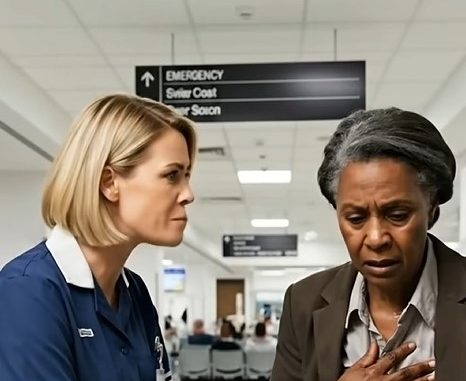
The emergency room was already tense that afternoon, filled with the usual rhythm of ringing phones, hurried footsteps, and families whispering prayers in plastic chairs. At the front desk, Linda Patterson stood rigid behind her computer, reviewing forms with practiced impatience. When a middle-aged woman with a bleeding hand approached, Linda barely glanced up.
“Ma’am, this ER is for insured patients, not charity cases,” she said sharply. “Where would someone like you even get insurance? We have standards here.”
Her voice rose intentionally, loud enough for the waiting families to hear. It was not simply policy she was enforcing. It was a performance.
The woman, Patricia, lowered her eyes. Her injured hand trembled—not from pain, but from disappointment. Blood soaked through the cloth she held against the wound. She did not argue. She did not plead. She simply waited, as if expecting exactly this.
Before the moment could harden further, a young nurse stepped forward.
“She’s bleeding,” said Emily Carter, her voice steady but urgent. “I’ll prepare treatment room three. She needs stitches now.”
Linda’s eyes narrowed. “Excuse me? Did I give you permission? You don’t make medical decisions, Emily. That’s above your pay grade.”
The waiting area fell quiet. Even the crying child near the vending machine stopped for a moment.
When Emily reached gently for Patricia’s arm, Linda reacted instantly. She grabbed the nurse’s sleeve. “If you touch that woman, you’re fired. Pack your things.”
Emily paused only a second. Then she pulled her arm free.
“Then fire me,” she said quietly.
She took Patricia’s uninjured hand and guided her toward the treatment corridor.
At that exact moment, the elevator doors slid open.
Doctor Robert Mitchell, the hospital’s chief of surgery, stepped out holding a coffee cup. He glanced toward the commotion—and froze. The cup slipped from his hand and shattered on the tile.
“No… Patricia?”
The name cut through the room like a bell. Conversations stopped. Screens flickered unnoticed.
Patricia looked up and smiled faintly. “Hello, Robert.”
His voice shook. “But I heard you were… I thought after the accident…” He saw her bleeding hand and dropped to his knees beside her. “What happened to you?”
“Car accident,” she replied calmly. “Two hours ago. Twelve stitches, according to my estimate.”
Doctor Mitchell helped her sit, then looked around, confused. “Why are you waiting out here?”
Patricia opened her worn canvas bag. Inside were medical credentials, a faded photo with the Surgeon General, and a check dated that morning—one point five million dollars.
Doctor Mitchell’s hands trembled as he read the name.
“This… this is you,” he whispered. “You built the children’s wing ten years ago. Your three-million-dollar donation saved hundreds of lives.”
Patricia nodded.
“For the last three years,” she said gently, “I’ve been volunteering in free clinics. Living in a trailer. I wanted to know if the values I built this place on still existed.”
Her eyes moved slowly to Linda.
“I think I have my answer.”
Linda’s face drained of color. Words failed her.
Doctor Mitchell stood, his expression no longer shocked—but resolute.
“Linda Patterson,” he said firmly, “you are terminated effective immediately. Security will escort you out.”
Then he turned to Emily.
“Emily Carter. You’re promoted to nursing supervisor. Full benefits starting today.”
Emily’s eyes filled with tears.
“Doctor Williams,” she whispered to Patricia, “your foundation paid for my nursing school. I never knew who…”
Patricia squeezed her hand gently. “That was always the point.”
Later, as Patricia’s wound was carefully stitched, Doctor Mitchell addressed the waiting room.
“Today,” he said, “we were reminded of something vital. Hospitals are built with bricks and machines—but they survive on character.”
Patricia added softly, “Because the ‘charity case’ you dismiss today may be the person who once built everything you stand on.”
And in that emergency room, among strangers and whispered apologies, dignity quietly reclaimed its place.