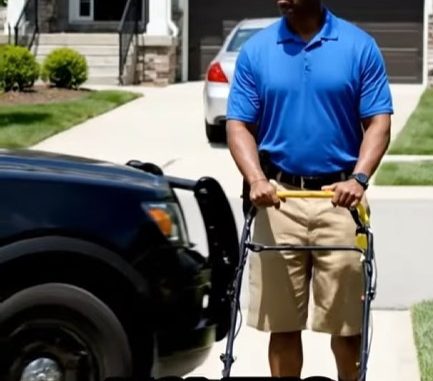
On a quiet afternoon in a peaceful suburban neighborhood, a man stepped outside to take care of something simple and ordinary. Well dressed, calm, and focused, he began mowing the lawn in his own driveway, enjoying the familiar rhythm of routine. To anyone passing by, it looked like nothing more than a homeowner tending to his property.
But moments later, the scene took an unexpected turn.
A police cruiser slowed to a stop beside the driveway. An officer stepped out, his posture firm, his expression cautious. He asked the man to turn off the mower and face him. Without hesitation, the man complied, placing the mower aside and turning with his hands visible, respectful and composed.
The officer asked what he was doing there.
“I’m mowing my lawn,” the man replied calmly.
The officer questioned whether the house truly belonged to him and requested identification. The man carefully produced his driver’s license. The address on the card matched the house perfectly. It should have been the end of the interaction.
But it wasn’t.
Instead of apologizing, the officer expressed doubt. He suggested the identification could be false and implied that the man did not belong in the neighborhood. The man did not argue. He simply explained that the officer could verify the information in seconds through the system.
That suggestion only seemed to make things worse.
The officer decided to detain him.
Handcuffs were placed on the man’s wrists as neighbors began stepping outside, curious and concerned. Several phones rose into the air, quietly recording everything that was unfolding. Some neighbors spoke up, saying they believed the man truly lived there. Others questioned what could possibly be suspicious about someone mowing their own lawn.
The man remained calm throughout it all.
Then something unexpected happened.
His phone began to vibrate in his pocket. Because his hands were cuffed behind his back, he could not answer. But the screen lit up clearly enough for others to see.
Six missed calls.
From the FBI Director.
A police supervisor arrived moments later and noticed the phone. His expression changed instantly. In the distance, sirens approached — not local patrol cars, but unmarked federal vehicles.
Within minutes, federal agents stepped out and approached the scene.
They calmly asked that the handcuffs be removed.
Turning to the man, they addressed him with quiet respect. They explained that they had been trying to reach him all morning. Only then did everyone realize the truth.
The man was not simply a homeowner.
He was a senior federal official.
The officer stood frozen as the reality settled in. The crowd fell silent. Internal Affairs quietly took over the situation.
In less than a minute, years of a career unraveled in front of dozens of witnesses.
As the man adjusted his wrists and prepared to leave, he did not raise his voice or express anger. His composure never changed. His final words were simple and calm.
“This is my home.”
The story spread quickly online, not because of scandal, but because of the lesson it carried.
Appearances can deceive.
Respect should never depend on assumptions.
And power, when misused, always leaves a record.
In the end, one ordinary afternoon became a reminder that dignity belongs to everyone — and that how we treat others matters more than titles, uniforms, or neighborhoods ever will.