The Entire Clinic Fell Silent After the Doctor Recognized the Man at the Front Desk
The clinic was overcrowded that afternoon, filled with tired patients, restless children, and the constant hum of ringing phones and distant conversations. Nurses moved quickly between hallways while people waited beneath harsh fluorescent lights, hoping their names would be called soon.
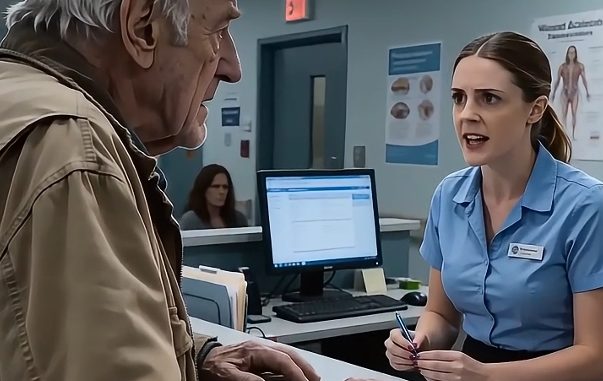
Near the front desk, an elderly man in a worn tan jacket stepped forward carefully. His brown cap looked faded from years of use, and his tired hands rested heavily on the counter as though he needed it to stay standing.
“I need to see the chief doctor,” he said quietly.
The receptionist barely looked at him before wrinkling her nose.
“Step back,” she snapped.
The old man blinked slowly, clearly uncomfortable with the attention suddenly turning toward him.
“Please,” he repeated softly. “It matters.”
Instead of helping him, the receptionist’s voice became louder.
“You smell terrible. Leave before I call security.”
The waiting room immediately fell silent.
A mother holding her sick child looked up from her chair. An older woman lowered her magazine. Even a man sitting in the corner stopped pretending not to listen.
The old man looked embarrassed, but he never argued.
He simply tightened his grip on the counter and whispered again, “Please.”
The receptionist leaned forward with visible irritation.
“I said leave.”
For a moment, it looked like the man might quietly walk away.
Then a door near the hallway suddenly opened.
A doctor wearing blue surgical scrubs stepped out quickly, focused on paperwork in his hands. He was clearly in the middle of a busy shift.
But when he heard the tension at the front desk, he looked up.
And froze.
His expression changed instantly.
“Dad?” he whispered.
The receptionist turned around in confusion while patients stared silently at the scene unfolding in front of them.
The older man slowly lifted his head. There was pain in his eyes, but something even stronger than pain.
Disappointment.
The doctor walked closer, visibly shaken.
“Why are you here?” he asked.
The old man reached carefully into his jacket while the entire waiting room watched.
For one terrifying second, nobody knew what he was about to pull out.
But instead of anything dangerous, he revealed a small envelope filled with old documents and newspaper clippings.
His hands trembled as he handed them to his son.
“I didn’t come for help,” he said quietly. “I came to warn you.”
The doctor opened the envelope with confusion. Inside were copies of complaints, reports, and signed statements from former patients and employees.
The old man explained that while visiting the clinic over the past several weeks, he had witnessed staff members humiliating elderly and poor patients who could not defend themselves.
Some had been ignored.
Others had been treated disrespectfully.
And many were too afraid or ashamed to report it.
“I wanted to believe it wasn’t true,” the old man said. “But today I saw it with my own eyes.”
The doctor’s face turned pale as he realized what had happened only moments earlier in front of the entire waiting room.
The receptionist stood speechless.
Patients looked around uncomfortably, many now remembering moments when they had witnessed similar behavior.
The doctor slowly turned toward the receptionist.
“No patient should ever be treated this way,” he said firmly.
He immediately apologized to his father in front of everyone before addressing the entire waiting room.
“Respect does not depend on appearance, money, or status,” he said. “Everyone who walks through these doors deserves dignity.”
Before returning to work, the doctor announced that the clinic would review staff conduct policies and patient treatment procedures immediately.
The old man said nothing more.
He simply nodded once, adjusted his old cap, and quietly walked toward the exit.
But this time, every person in the room watched him with respect.