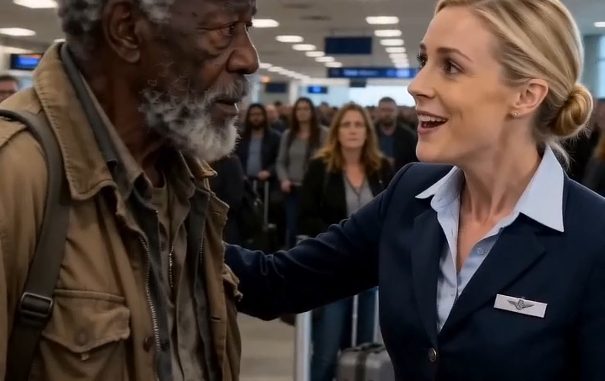
The entire boarding gate went silent after the captain’s voice cut through the noise.
“Step away from him. Now.”
The flight attendant froze with the old veteran’s boarding pass still in her hand. Only moments earlier, she had treated him like he did not belong in the first-class line. She had judged his worn jacket, his faded cap, and the old duffel bag hanging from his shoulder.
But the captain was not looking at his clothes.
He was looking at the man.
The old veteran stood quietly near the boarding entrance. He did not shout. He did not argue. He only held his dignity while everyone watched.
The captain walked straight toward him, stopped in front of him, and gave him a respectful salute.
Gasps moved through the passengers.
The flight attendant’s face changed instantly.
“Sergeant Williams,” the captain said, his voice softer now. “I know exactly who you are.”
The old man looked surprised.
“Captain?” he asked quietly.
The captain lowered his hand from the salute, but his respect remained clear.
“My father served overseas,” he said. “He told me about the man who helped bring his unit home when everything went wrong. He never forgot your name.”
The crowd that had been whispering just seconds before became completely still.
The veteran looked down for a moment, as if the memory was heavy. Then he nodded slowly.
“I only did what any soldier should do,” he said.
The captain shook his head.
“No, sir. You did more than that.”
Then the captain turned toward the flight attendant.
“This passenger had a valid ticket,” he said firmly. “He deserved respect from the first second he arrived.”
The attendant swallowed hard.
“I’m sorry,” she said quickly. “I didn’t know—”
The captain interrupted calmly.
“That is the problem. You thought you needed to know who he was before treating him properly.”
No one spoke.
The attendant lowered her eyes, embarrassed in front of the passengers she had tried to impress.
The captain picked up the veteran’s old duffel bag himself.
“Sergeant Williams,” he said, “please allow me to escort you aboard.”
The old veteran hesitated.
“You don’t have to do that.”
The captain gave a small respectful smile.
“Yes, sir. I do.”
As they walked toward the aircraft door, the same passengers who had laughed moments earlier stepped aside in silence. Some lowered their phones. Others looked ashamed for watching without helping.
Near the jet bridge, the captain paused and turned back to the staff.
“From now on,” he said, “no passenger is judged by clothes, age, or appearance. Everyone gets dignity here.”
The flight attendant nodded, unable to answer.
Inside the plane, the captain personally guided the veteran to his seat. Before leaving, he placed the old duffel bag carefully above him and shook his hand.
“Thank you for your service,” the captain said.
The veteran’s eyes softened.
“Thank you for remembering,” he replied.
A few passengers nearby began to clap softly. Soon, the applause spread through the cabin—not loud or dramatic, but sincere.
The veteran sat down quietly, not as a man who wanted attention, but as someone who had finally been seen.
And the flight attendant, standing at the front of the plane, understood the lesson clearly: respect should never depend on someone’s appearance.
The End.