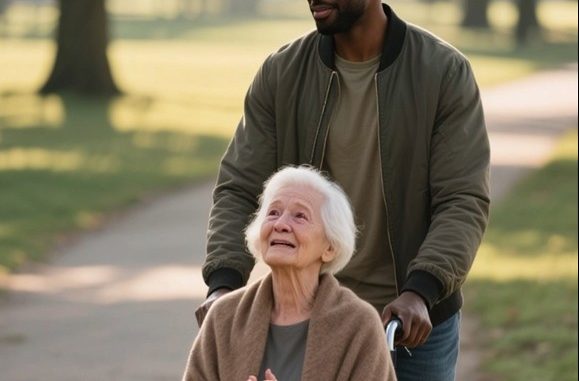
The park was peaceful that evening, the warm glow of sunset stretching long shadows across the path. Mrs. Thompson, an elderly woman in her late seventies, slowly maneuvered her wheelchair along the walkway. Life had made her cautious, but not helpless — she was simply moving from one bench to another, taking in the quiet of the evening.
As she approached a small sitting area, a group of teenagers gathered nearby began speaking loudly. Their laughter grew sharper, echoing across the park. Though they didn’t know her, their teasing remarks made Mrs. Thompson tense. She clutched her walker with trembling hands, hoping someone would notice her discomfort.
That someone was Marcus Allen.
Marcus wasn’t in uniform, nor did he hold any official title. He was simply passing through the park after a long day. But when he saw Mrs. Thompson surrounded and clearly distressed, he paused — then stepped forward without hesitation.
With a calm but firm presence, Marcus positioned himself between her and the group.
“Let’s give her some space,” he said, his voice steady and respectful.
There was no anger in his tone — just sincere authority.
The group fell silent for a moment, unsure how to respond. What they expected to be a quick moment of teasing was suddenly met with a wall of quiet strength. Marcus didn’t yell or threaten. He simply stood his ground with compassion, making it clear that he wouldn’t allow anyone to intimidate someone vulnerable.
For a few tense seconds, the air seemed to stand still.
Then something remarkable happened.
People walking by began to notice. One by one, they stepped closer — not aggressively, but as a show of unity. A couple jogging nearby paused, an older man approached with concern, and a mother walking with her child stopped to stand beside Marcus. A small circle of support formed around Mrs. Thompson.
What started as one person defending her quickly became a community standing together.
Realizing the situation had changed, the group backed away. They weren’t confronted — just met with a level of quiet solidarity they didn’t expect. Without a single raised voice, the moment became a powerful reminder of how compassion can shift an entire atmosphere.
Marcus gently guided Mrs. Thompson down the path, pushing her wheelchair with steady hands. She looked up at him with gratitude shining in her eyes.
“Thank you,” she whispered.
“It’s no trouble,” he replied softly. “Everyone deserves to feel safe.”
The ripple effect of that evening spread fast. Witnesses shared the story online, describing how one person’s calm courage inspired an entire park to act. Local community groups reposted it, calling it a reminder of how small actions can make the biggest difference.
Later that night, Mrs. Thompson reflected on the event. Fear had been present — but kindness won. And in that victory, Marcus reminded everyone watching that heroism doesn’t require a badge, a title, or recognition. Sometimes, it’s simply the choice to stand up when it matters most.
The story continues to be shared because it highlights a truth often forgotten:
In a world that can feel indifferent, courage and kindness still exist — and they grow when one person leads the way.