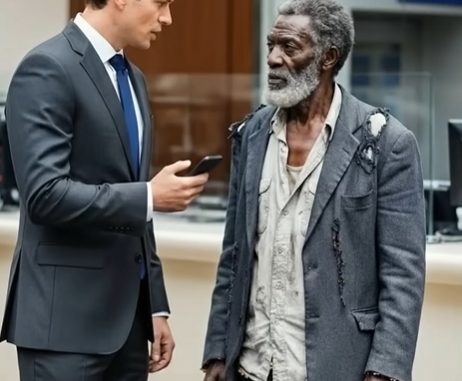
On a busy weekday morning, the lobby of First National Bank looked exactly as it always did—polished marble floors, quiet murmurs, and customers dressed in tailored suits moving efficiently between counters. For the employees behind the desks, it was another routine day. Until one unexpected visitor walked through the glass doors.
A man in worn clothes entered slowly, carrying a scuffed Italian briefcase with silver initials. His jacket was torn, his shoes dusty, and the faint scent of shelter clung to him. A few heads turned. Some people frowned. Others whispered. To many in the room, he looked like someone who had wandered into the wrong building.
Richard Bradford, a junior manager eager to impress, noticed him immediately. He smirked and whispered into his phone camera, amused by the sight. When the man approached the counter and asked calmly about opening a VIP account, Richard laughed openly.
“This is a bank, sir,” Richard said loudly. “You need identification, proof of income—things you clearly don’t have.”
The man did not raise his voice. He simply stood there, gripping his briefcase. On his wrist rested an old, scratched watch that few recognized, though its quiet value exceeded most cars in the parking lot.
At a nearby teller window, Jennifer Haze looked up. She saw not a nuisance, but a human being standing alone under judgment. When she offered help, Richard snapped at her.
“He’s wasting our time,” Richard insisted. “That briefcase is probably stolen. If you don’t walk away, I’m calling security.”
Jennifer hesitated. Her hands trembled, but she stepped forward anyway. “Sir, please come to my window,” she said gently.
That moment changed everything.
Richard called security and demanded both of them be removed. Just then, the heavy vault door behind the counters opened. William Anderson, the regional director, walked out reviewing paperwork. His eyes lifted, scanning the lobby—and then froze.
The tablet slipped from his hands and shattered on the marble floor.
“Marcus?” he whispered.
The room fell silent.
The man slowly raised his head. “Hello, William.”
William staggered forward, dropping to his knees in front of him. His voice shook as he grasped the man’s hands. “They said after Sarah died, you disappeared… What are you doing here like this?”
Marcus Thompson’s reply was soft, almost hollow. “Cancer took everything that mattered. I sold our penthouse and donated most of it to research. I’ve been living simply ever since.”
Then he opened the briefcase.
Inside were faded photographs, founding documents, and stock certificates bearing a familiar signature. Papers showing forty percent ownership. A ribbon-cutting photo with a former president. Proof that the man everyone had mocked was the very founder of the bank.
William stood slowly, his expression shifting from shock to quiet fury. “This man built this entire institution,” he said firmly. “Including every job in this building.”
Marcus spoke again, gently. “I wrote our mission myself. Banking for every American, regardless of circumstance. I came back to see if those words still meant anything—or if they were only decoration.”
Richard’s phone slipped from his hand. His face turned pale.
“Richard Bradford,” William said sharply, “you are terminated immediately. Security will escort you out.”
Then he turned to Jennifer. “Effective now, you are Assistant Branch Manager. Full salary and benefits.”
Tears filled her eyes. “Mr. Thompson… years ago I received a scholarship letter. From the Thompson Foundation. That letter saved my family. I never knew who sent it.”
Marcus smiled softly and squeezed her hand. “I don’t need money anymore,” he said. “I only needed to know kindness still lives here.”
As he walked out, no one whispered. No one laughed. The marble walls of First National had witnessed something rare that morning—not a transaction, but a reminder.
Status fades. Titles change. Wealth disappears.
But character, once shown, stays forever.