In a world increasingly shaped by appearances, professional titles, and outward symbols of success, it is easy to mistake position for character and wealth for worth. Society often teaches us to admire polished suits, luxury vehicles, and influential job titles. Yet, beneath the surface of these symbols lies a far more meaningful measure of a person: how they treat others when there is nothing to gain. A recent viral story involving a businessman and an elderly fruit vendor offers a powerful reminder that dignity, empathy, and humility remain the true foundations of lasting respect.
A Moment of Carelessness
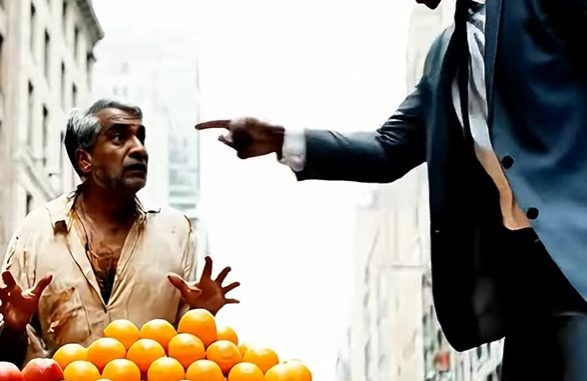
The story unfolds on a crowded city sidewalk, where the daily rhythm of hurried footsteps and impatient glances rarely leaves room for reflection. An elderly man stood beside a modest wooden cart, selling oranges to passersby. His hands were worn, his posture slightly bent with age, and his livelihood depended on the few coins people chose to spare.
Into this ordinary scene walked a young businessman, dressed sharply in a tailored grey suit, sunglasses reflecting confidence and ambition. His schedule was tight, his phone buzzed constantly, and his attention remained fixed on his next appointment. When he noticed the fruit cart partially blocking his path, irritation replaced patience.
Rather than offering a simple request, the businessman reacted impulsively. With a careless motion, he struck the cart, sending oranges scattering across the pavement. The elderly vendor fell to his knees, scrambling to retrieve the fruit that represented his entire day’s work. Confused and shaken, he looked up in silence, hoping for an apology that never came.
Instead, the businessman adjusted his tie, offered a faint smirk, and continued on his way—momentarily convinced that power granted immunity from consequence.
The Quiet Arrival of Perspective
Unbeknownst to him, the moment had not gone unnoticed. A luxury vehicle had stopped nearby, and from it emerged an older gentleman with calm authority and measured steps. This man was not a stranger; he was the businessman’s employer, a respected leader known for his principled approach to business and life.
Rather than confronting his employee immediately, the employer chose a different path. He approached the fallen vendor, knelt beside him, and began helping gather the scattered oranges. Without raising his voice or drawing attention, he demonstrated something far more powerful than words: respect in action.
Passersby slowed, drawn by the unexpected contrast between wealth and humility. In that quiet gesture, the meaning of leadership became visible—not through command, but through compassion.
Accountability in Action
When the young businessman finally noticed his employer, he approached confidently, expecting acknowledgment or approval. What he encountered instead was silence and steady disappointment. The employer had witnessed the entire incident and recognized it as more than a lapse in manners—it was a reflection of character.
In professional life, performance metrics often dominate discussions. Productivity, efficiency, and results shape careers. Yet, for leaders who understand the long-term value of trust and integrity, character remains the ultimate qualification.
With calm resolve, the employer explained that behavior toward others reveals how one will behave under pressure, in negotiations, and within teams. A person who lacks empathy in public cannot be trusted with responsibility in private. The decision was immediate: the young man’s employment ended that day.
It was not punishment driven by anger, but a principled choice guided by values.
Restoring Dignity
After addressing the misconduct, the employer turned fully toward the elderly vendor. He purchased the remaining fruit and quietly offered financial support sufficient to replace what had been lost and more. Yet, more important than the money was the respect he offered—listening to the man’s story, thanking him for his work, and acknowledging his dignity.
Tears welled in the vendor’s eyes, not because of the generosity alone, but because someone had chosen to see him not as an obstacle, but as a human being.
A Broader Reflection
Stories like this resonate because they mirror situations many recognize, if not personally then through observation. Success often brings influence, and influence can tempt people to forget humility. Yet, history repeatedly shows that reputations are built not on titles, but on choices made in moments when no reward is expected.
True leadership is revealed in ordinary places: on sidewalks, in waiting rooms, at restaurant tables, and in quiet acts of fairness. It is in these moments that values are tested.
Lessons That Endure
This encounter leaves behind several enduring lessons:
Empathy is strength, not weakness. Kindness reflects confidence, not vulnerability.
Status is temporary. Positions change, fortunes shift, but character endures.
Integrity defines leadership. Respect cannot be demanded; it is earned through conduct.
Every action leaves an echo. People remember how they are treated long after titles fade.
In the end, the young businessman lost a job, but gained a lesson that could shape the rest of his life. The elderly vendor gained more than compensation; he regained dignity. And those who witnessed the scene were reminded of a simple truth: while success may open doors, only character keeps them open.
Because in a world obsessed with appearances, the most powerful legacy remains invisible—the legacy of how we choose to treat one another.