In a world that moves quickly and judges even faster, moments of quiet misunderstanding can reveal powerful truths about respect, dignity, and the stories people carry with them.
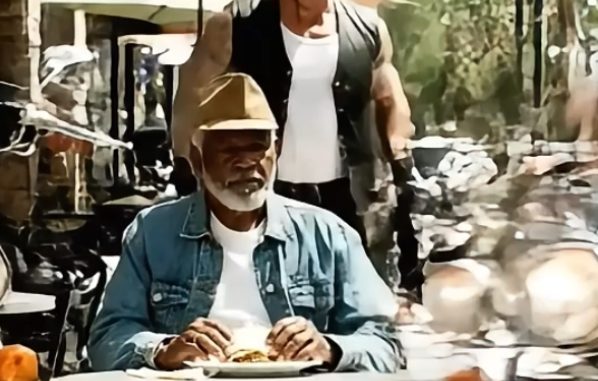
One afternoon, at a small outdoor café, an elderly man sat alone enjoying a simple lunch. His movements were slow but steady. His clothes were modest, worn by time rather than neglect. To most people passing by, he appeared ordinary — the kind of person many overlook without a second thought.
The calm atmosphere changed when the sound of roaring motorcycle engines broke the silence. A group of bikers pulled in and parked near the café. Their arrival was loud, energetic, and impossible to ignore. As they removed their helmets and looked around, their attention quickly settled on the elderly man sitting at one of the tables.
At first, the interaction seemed like casual teasing. A few comments were made, light laughter shared among the group. But what began as playful quickly shifted into something more uncomfortable. The man’s quiet presence was interpreted as weakness. His silence was mistaken for uncertainty. His calm demeanor was misunderstood as someone who didn’t belong.
The elderly man did not argue. He did not raise his voice. He simply continued eating.
Sometimes, dignity is most visible in restraint.
As the bikers continued their remarks, a small detail changed the atmosphere — a glimpse of something beneath the man’s jacket. A subtle flash of metal caught the light. At first, it went unnoticed. Then someone pointed it out. What had seemed insignificant suddenly introduced doubt.
Moments later, the situation shifted completely.
A black vehicle pulled up nearby. Unlike the roaring motorcycles, its arrival was quiet but carried a different kind of presence — controlled, official. Two uniformed officers stepped out and walked directly toward the elderly man, passing the bikers without hesitation.
Their posture was not casual. It was respectful.
They addressed the man with calm professionalism, the kind reserved for someone whose life reflects service and responsibility. As the elderly man slowly stood, his jacket opened fully, revealing the medals he wore — not as decoration, but as history.
The realization spread instantly.
What had been interpreted as weakness was, in reality, strength shaped over decades. What had looked like an ordinary lunch was a pause in a life defined by sacrifice, discipline, and contribution.
The energy among the bikers changed. Voices grew quieter. Body language shifted. The same space that moments earlier carried mockery now held reflection.
No confrontation was necessary. No lecture was delivered. The truth spoke for itself.
Stories like this resonate because they challenge a common habit: judging people based on surface impressions. Modern culture often celebrates visibility — status, appearance, noise. Yet many of the most meaningful lives are not loudly displayed. They are carried quietly.
Respect, unlike recognition, should not depend on discovering someone’s achievements.
The elderly veteran did not demand acknowledgment. He did not reveal his past to prove a point. He simply existed with dignity. And that dignity, once recognized, reshaped the entire moment.
These encounters serve as reminders that every person carries a story that cannot be seen at first glance. Experience, sacrifice, kindness, resilience — these rarely announce themselves. They reveal themselves slowly, often when least expected.
In the end, the scene returned to calm. The veteran resumed his lunch. The noise faded. But the impact of the moment remained — not because of conflict, but because of perspective.
Sometimes the strongest lesson is simple: respect should come first, not after the explanation.