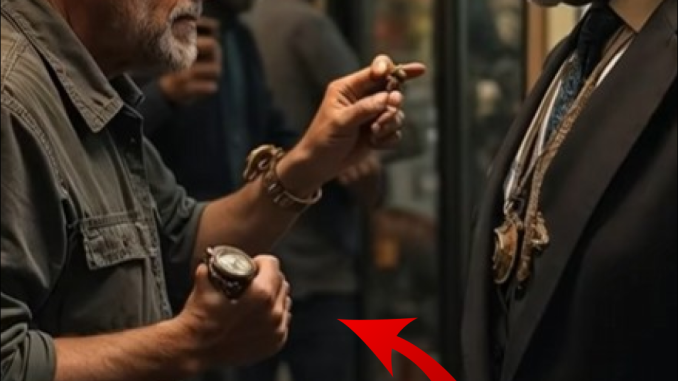
It was a quiet afternoon when Marcus Thompson pushed open the door of a small watch repair shop. The bell above the entrance rang softly, the kind of sound that usually goes unnoticed.
Marcus was seventy-three years old, a veteran who carried himself with calm dignity. His clothes were simple, worn from years of everyday life rather than display. On his wrist sat an old watch — scratched, faded, and no longer ticking.
But the watch was never just an object.
It had been a gift from his father — also a veteran — given to Marcus before he left for service decades earlier. It represented protection, memory, and a connection between two generations shaped by sacrifice.
Marcus approached the counter and asked politely if the watch could be repaired.
The shop owner looked at it briefly. His reaction was immediate.
He shook his head.
“We don’t repair watches like this,” he said. His tone suggested certainty rather than curiosity. To him, the watch looked inexpensive, worn, and not worth the time.
Marcus remained calm. He explained the watch belonged to his father and meant a great deal to him. He didn’t ask for special treatment — only for someone to look at it.
The owner dismissed the request again, suggesting the watch was likely not authentic. He spoke as if the decision was obvious.
For a moment, silence filled the shop.
Marcus slowly removed the watch and placed it on the counter.
“My father gave me this before I left,” he said quietly. “He wore it before me.”
Something in his voice shifted the atmosphere. Not dramatic — just honest.
A young technician working in the shop glanced over. Curiosity replaced assumption. She picked up the watch carefully and examined the details more closely — the case, the engraving, the movement.
Her expression changed.
She called the owner over.
“This isn’t fake,” she said. “This is a vintage military piece. Extremely rare.”
The owner looked again — this time properly.
The small details he ignored before now stood out clearly. The craftsmanship. The markings. The history behind the object. The watch carried far more value than he had assumed — not only financially, but historically.
In fact, its worth exceeded the value of many pieces displayed in the shop.
The realization was immediate.
But what mattered most wasn’t the price.
It was the mistake.
Marcus hadn’t raised his voice. He hadn’t argued. He simply stood there with patience — allowing the truth to surface on its own.
The owner apologized. Not because the watch was valuable, but because he had judged before understanding.
The technician offered to repair the watch personally, treating it with the care it deserved.
Marcus accepted with a small nod.
Weeks later, the watch ticked again.
And the story spread — not as a story about luxury, but as a reminder about respect. About how easily people form conclusions based on appearance, and how often those conclusions are wrong.
The watch represented two veterans, two generations, and time that carried meaning far beyond material value.
Because sometimes the true worth of something — or someone — cannot be seen at first glance.
And sometimes a simple repair becomes a powerful lesson.