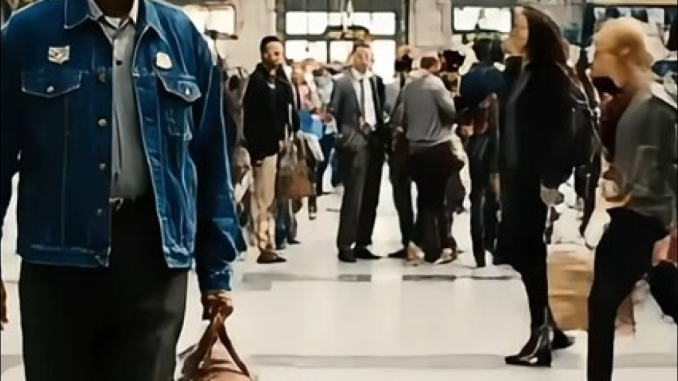
The station was busy, filled with the familiar rhythm of announcements, footsteps, and travelers moving with purpose. Among them stood a man waiting quietly near the platform, holding a small bag and checking the time.
He wasn’t drawing attention. He was simply waiting for his train.
Moments later, a station employee approached him with urgency. The tone was firm, direct, and immediately public.
“You are not authorized to be in this area,” the employee said. “I am asking you to leave immediately.”
The man looked surprised but remained calm. He explained that he was waiting for his train, like everyone else. His voice stayed measured, respectful.
“I have every right to be here,” he replied.
The employee did not soften. Instead, the situation escalated. The words became sharper, louder, attracting the attention of nearby passengers.
“This area isn’t for you,” the employee insisted.
The man paused for a moment, absorbing the statement. There was no anger in his expression — only quiet disbelief.
“You’re judging me without asking a single question,” he said.
But the employee seemed certain. Sometimes certainty appears before understanding, and in public spaces, that certainty can shape how a moment unfolds. The employee repeated the assumption, convinced the decision was correct.
“I can tell enough,” the employee said again.
The man took a breath. He didn’t raise his voice. He didn’t argue aggressively. Instead, he reached into his pocket and calmly showed an identification badge.
“I belong here,” he said.
The employee leaned closer, confused.
“What is that?” he asked.
“The truth you didn’t wait for,” the man replied.
The badge revealed something unexpected. The man standing quietly near the platform was not a passenger out of place — he was the director of the train station.
For a brief moment, the noise of the station seemed to fade.
The dynamic shifted instantly. What had started as a public confrontation became a lesson about assumptions, professionalism, and the importance of asking before concluding.
The director spoke calmly, without anger.
He explained that how people are treated in everyday moments matters deeply — especially in places meant to serve everyone. Leadership, he noted, is not only about managing systems but about protecting dignity.
The employee’s confidence disappeared, replaced by realization.
The director made it clear that behavior toward passengers must reflect respect first. Actions have consequences, particularly when they affect the experience of others.
The conversation ended not with humiliation, but with accountability. The employee apologized sincerely, understanding the mistake was not about authority — it was about judgment.
“I’m so sorry, sir,” the employee said.
The director accepted the apology. The moment was not about power, but about learning.
Nearby passengers returned to their routines, but many carried the quiet message the situation left behind: appearances do not tell the full story.
Public spaces bring together people from different backgrounds, roles, and journeys. Respect is the one constant that should never depend on assumptions.
The train eventually arrived. The director boarded like any other traveler, without attention or ceremony.
But the lesson remained.
Sometimes the most important reminders come from ordinary moments — moments that show how quickly judgment can happen, and how powerful simple respect can be.
Because belonging is not something others decide at first glance.
And sometimes, the truth only appears when someone chooses to look.