A quiet roadside diner rarely becomes the center of a powerful lesson about dignity, respect, and the unseen battles people carry with them. Yet one ordinary evening, a simple interaction between a returning soldier and a diner manager sparked a story that would resonate far beyond the walls of that small restaurant.
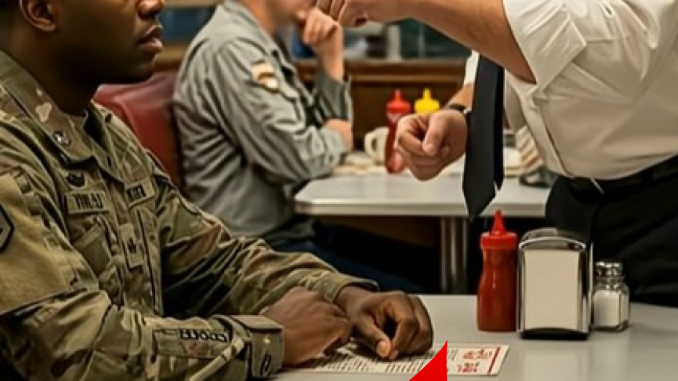
Sergeant Marcus Hill had just returned home after nine months overseas. Still wearing his camouflage uniform, boots dusty from deployment, he stopped at a diner he remembered from childhood. He wasn’t looking for recognition or special treatment. He just wanted a warm meal, a place to sit, and a few moments of normal life after months of service.
When Marcus walked in, conversations softened. Some customers glanced at him with curiosity, others with quiet respect. But the manager reacted differently.
Without a greeting, the manager approached Marcus with a tense expression and a guarded tone. What began as a simple exchange quickly turned uncomfortable. Instead of welcoming a tired customer, the manager questioned his presence and suggested he should leave.
Marcus was stunned — not because of raised voices, but because of what the moment represented. After months of sacrifice, he found himself being asked to leave a place where he had once felt at home.
Several customers noticed the tension. One older couple exchanged concerned looks. A few people shifted in their seats, unsure whether to speak. The room carried that familiar silence that appears when something feels wrong but no one knows how to interrupt it.
Marcus didn’t argue. He didn’t raise his voice. He didn’t try to prove anything.
Instead, he responded with calm.
He explained that he simply wanted a meal. Nothing more. His posture remained steady, his voice controlled — the kind of composure learned not in comfort, but in discipline.
The manager remained firm.
In that moment, Marcus made a quiet decision. He placed money on the table, even though he had not been served. He picked up his cap, preparing to leave with the same dignity he had walked in with.
But before stepping out, he paused.
His final words were not loud, emotional, or confrontational. They were measured — the kind of words that carry weight because they are calm.
“None of our soldiers will come to this diner again.”
The sentence was simple, yet it changed the atmosphere instantly. Customers understood that this moment was bigger than a single meal. It was about belonging. About respect. About how small interactions can shape how people feel when they return home.
Marcus left without looking back.
In the days that followed, the story began to spread — not because Marcus attacked anyone, but because he chose dignity. People responded to the quiet strength of his reaction. Veterans shared similar experiences. Others reflected on how easily everyday moments can either uplift someone or push them away.
What stayed with many was not the conflict itself, but Marcus’s restraint. He did not respond with anger. He responded with clarity.
The story became a reminder that respect is rarely about grand gestures. It lives in ordinary encounters — in greetings, in tone, in the simple decision to treat someone as welcome.
Uniforms represent service, but dignity represents character. And character, as Marcus showed, often speaks loudest when the voice remains calm.