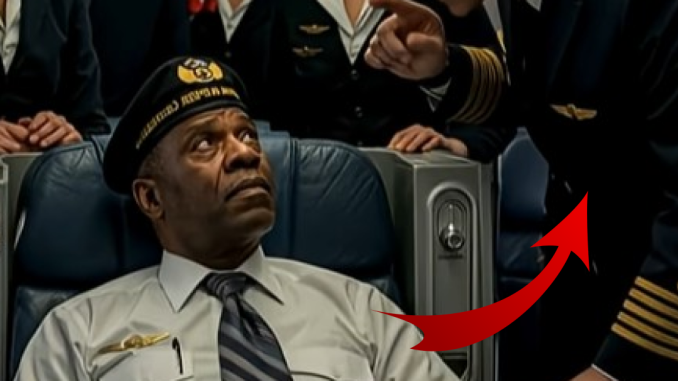
On what seemed like a routine morning flight from New York to San Francisco, passengers boarded with the quiet efficiency typical of early departures. Carry-on bags slid into overhead bins, flight attendants welcomed travelers with polite smiles, and the hum of preparation filled the first-class cabin.
Among the passengers sat Mr. Charles Bennett, a well-dressed man in his 60s. His appearance was simple — a white shirt, a navy tie, and a calm demeanor that suggested someone comfortable with silence. He took his seat, placed his hands gently on the armrests, and looked out the window, just another traveler beginning his day.
But moments later, the atmosphere shifted.
When the pilot entered the cabin, his attention locked onto Mr. Bennett. He paused, studying him with visible skepticism. What followed was a brief but tense exchange that nearby passengers could not ignore. The pilot questioned whether Mr. Bennett was seated in the correct place — a moment that immediately created discomfort in the cabin.
Mr. Bennett responded calmly, explaining that he had purchased the seat like everyone else. His voice was steady, respectful, and free of confrontation. Yet the tension lingered, growing heavier as passengers sensed that something deeper was unfolding.
The situation reached its peak when the pilot pressed further, implying that appearances did not match expectations. Conversations stopped. Flight attendants exchanged uncertain glances. The cabin, once routine and quiet, became a space of collective attention.
Then everything changed.
A passenger seated nearby spoke up, not with anger but with clarity. She recognized Mr. Bennett and revealed something that shifted the entire narrative. Mr. Bennett was a retired Air Force colonel — a decorated veteran who had spent decades training pilots and contributing to aviation safety. His experience and service had influenced countless professionals in the very field now questioning him.
The realization spread quickly. The tension that had filled the air gave way to silence — not awkward silence, but reflective silence.
A senior flight attendant stepped in, handling the situation professionally and guiding the interaction toward resolution. The moment was no longer about authority or seating assignments. It became a reminder about assumptions and the importance of respect.
Mr. Bennett did not raise his voice. He did not demand recognition. Instead, he returned his gaze to the window, composed and unbothered — the posture of someone who understood that dignity does not depend on validation.
What made the moment powerful was not confrontation, but contrast. Calm versus assumption. Experience versus appearance. Character versus perception.
Stories like this resonate because they highlight something universal: respect should never be conditional. We encounter people every day whose histories, achievements, and struggles are invisible at first glance. Judging too quickly risks overlooking extraordinary lives.
In a world that often emphasizes status symbols and visible success, this story reminds us that quiet presence can carry remarkable depth. Titles fade, uniforms retire, and roles change — but character remains.
The flight continued as scheduled. Passengers settled back into their seats. Yet many carried with them a subtle lesson that extended far beyond travel.
Sometimes the most important reminders arrive in ordinary places — a seat on a plane, a brief conversation, a moment of pause.
And sometimes dignity speaks loudest when it speaks softly.