Moments of misunderstanding can unfold quickly, especially in places where appearances often shape first impressions. One recent incident outside an upscale restaurant offers a powerful reminder of how easily judgment can replace curiosity — and how important it is to pause before making assumptions.
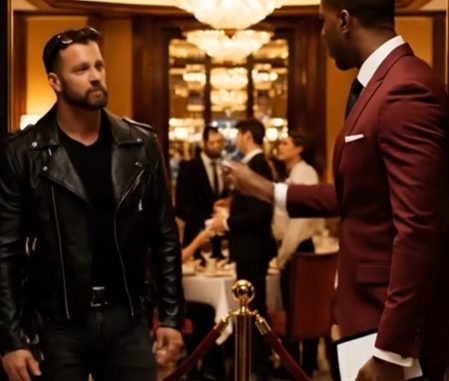
On a busy evening, guests gathered outside a well-known restaurant hosting a charity dinner. The atmosphere was elegant, with formal attire, soft lighting, and a steady flow of arrivals. Among them, a man wearing a worn leather vest approached the entrance, accompanied by several friends dressed in similar biker clothing.
As he stepped toward the doorway, the host moved forward and stopped him. The host explained that the restaurant had a dress code and suggested that the man’s clothing did not meet the standard expected for the evening. The exchange quickly became tense. The man calmly stated that he was there for the charity event, but the host remained firm, insisting that entry would not be possible.
Nearby guests began to notice the interaction. The man maintained composure and repeated that he had been invited, yet the situation escalated as the host, relying on visible appearance alone, concluded that the group did not belong at the event. After a brief pause, the man nodded and turned away with his friends, choosing not to argue further.
At that moment, the raised voices drew the attention of the restaurant’s owner, who stepped outside to understand what was happening. After asking a simple question — why the guests were being turned away — the owner looked at the man and immediately recognized him.
The situation changed instantly.
The owner clarified that the man had played a central role in supporting the charity dinner. In fact, his contribution had helped make the entire event possible. What had appeared to be an ordinary disagreement at the entrance was suddenly revealed as a clear example of how assumptions can lead to mistakes.
The owner addressed the situation calmly but firmly, explaining that hospitality begins with respect and that decisions should never be based solely on appearance. The host, visibly uncomfortable, acknowledged the misunderstanding and offered an apology.
Rather than responding with frustration, the man emphasized a simple message: people deserve to be asked, not judged. His response shifted the moment from confrontation to reflection, highlighting the broader lesson behind the encounter.
The group was then welcomed inside, this time with appreciation rather than hesitation. The earlier tension gave way to a quieter realization shared by those who witnessed the exchange — that kindness, curiosity, and professionalism matter most in moments of uncertainty.
Stories like this resonate because they mirror everyday experiences. Many people have faced situations where assumptions created barriers that could have been avoided with a single question. The lesson is not about blame but about awareness.
First impressions are powerful, but they are not always accurate. Choosing to pause, ask, and listen can transform an interaction completely.
In the end, the evening continued as intended: a charity event focused on helping others. Yet for those present, the most meaningful takeaway happened before anyone even entered the restaurant — a reminder that respect should never depend on appearance, and that understanding always begins with a conversation.