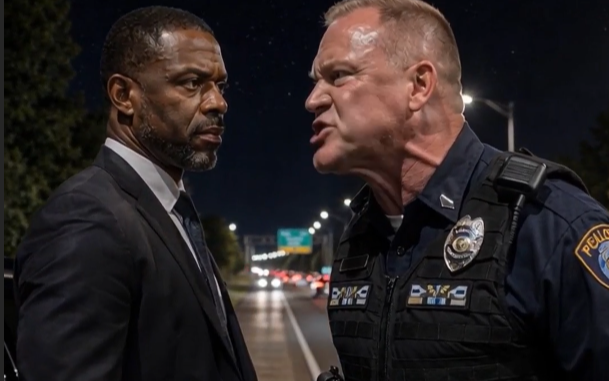
It was late at night on a quiet road, with only the glow of streetlights and passing headlights breaking through the darkness. A well-dressed man had stopped near the roadside, calm and composed, when a police officer approached him with visible anger.
Instead of beginning with a respectful question, the officer immediately took an aggressive tone.
“What are you doing stopped here like this?” he demanded. “You don’t belong on these roads at night.”
The man remained still. He did not raise his voice. He did not argue back. He simply looked at the officer and listened.
But the officer continued. His words became more personal and more disrespectful. He accused the man of being suspicious without presenting clear evidence. He claimed he knew “exactly” what the man was doing and ordered him to empty his pockets.
For a moment, the quiet road felt heavier than before. Passing cars slowed slightly. A few people nearby looked over, sensing that something was wrong. The officer’s behavior was no longer just firm; it had crossed into intimidation.
The man finally spoke, calmly but firmly.
“You better back off right now,” he said, “before you dig a hole you can’t climb out of.”
The warning should have made the officer pause. Instead, he pushed harder. He spoke as if the road belonged to him personally, not to the public. He acted as though authority gave him permission to judge someone by appearance, location, or assumption.
That was the mistake.
The man’s expression did not change. He reached into his jacket carefully and identified himself.
He was not a criminal. He was not causing trouble. He was an off-duty federal judge.
The officer’s confidence disappeared almost instantly.
The judge’s voice stayed controlled, but every word carried weight.
“You just harassed and falsely accused a federal judge,” he said.
The officer froze. The situation he had tried to control was now completely out of his hands. His badge did not protect poor judgment. His uniform did not excuse disrespect. His authority did not give him the right to threaten someone without reason.
Within moments, the consequences became clear. The judge informed him that his actions had ended his career that night. He was told to hand over his badge and gun immediately.
The officer stood silent, realizing too late that the person he had tried to intimidate had the power to hold him accountable.
But the real lesson was not only about title or position. It was about conduct.
A person should not need to be important to be treated with dignity. A citizen should not have to reveal a powerful job title before receiving basic respect. Authority is meant to protect people, not frighten them. It is meant to serve the law, not personal pride.
That night, one officer learned that assumptions can destroy trust in seconds. He judged too quickly, spoke too harshly, and allowed arrogance to replace professionalism.
The judge walked away unharmed, but the moment left a lasting message for everyone who witnessed it.
Respect should never depend on someone’s clothes, face, job, or where they happen to be standing at night. Real authority is not shown through threats. It is shown through fairness, discipline, and self-control.
And when someone abuses power, accountability can arrive faster than they ever expected.