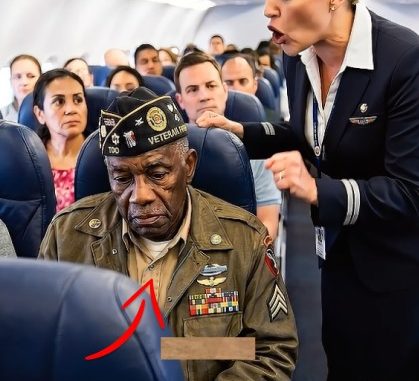
The airport terminal was crowded with travelers rushing toward their gates, dragging suitcases behind them and checking their phones for boarding updates. Among the crowd was an elderly black man walking carefully with a small leather bag over his shoulder.
He wore a simple jacket decorated with a few old military pins. Most people barely noticed him as he boarded the airplane quietly and entered the business-class cabin.
After checking his boarding pass, he sat beside the window and placed his bag neatly under the seat in front of him.
For a few peaceful moments, everything seemed normal.
Then a white female flight attendant approached him with a cold expression.
“What does an old man like you want here?” she asked.
Nearby passengers immediately looked up from their phones.
The elderly man remained calm.
“I’m sitting where my ticket says I belong,” he answered politely. “Is there a problem?”
The attendant crossed her arms.
“Of course there’s a problem,” she replied. “This is business class. Passengers like you usually sit near the back, close to the bathrooms.”
The cabin suddenly became quiet.
Some passengers looked uncomfortable, but nobody spoke.
The old man slowly held up his boarding pass.
“This seat was assigned to me,” he said calmly.
But the attendant refused to listen.
“Either leave now,” she warned, “or I’ll call someone to remove you from this section.”
The veteran looked directly at her.
“The entire airline can come here,” he replied firmly, “but nobody is moving me.”
The confident response surprised several passengers.
The flight attendant immediately called for assistance.
Only moments later, a tall black man wearing an elegant dark suit entered the business-class cabin from the front of the aircraft. His airline badge identified him as a senior operations executive.
He looked around carefully before noticing the elderly passenger.
His expression changed instantly.
“Sir,” the executive said respectfully to the elderly man, “it’s an honor to see you again.”
The passengers exchanged confused looks.
Then the executive slowly turned toward the flight attendant.
“Can someone explain what’s happening here?” he asked firmly.
The attendant hesitated.
“I was trying to help,” she said nervously. “I thought he was sitting in the wrong section.”
The executive stared at her for a moment.
“You thought wrong,” he replied.
The cabin remained silent as he continued speaking.
“This man is a decorated veteran and one of our honored lifetime guests. He has flown with this airline for years, and his service to this country earned him permanent priority privileges.”
The attendant’s face lost color.
The executive continued:
“Instead of treating him with respect, you embarrassed him publicly in front of passengers.”
Several travelers nodded quietly after hearing the explanation.
The elderly man still remained calm, never once raising his voice.
The executive then addressed the cabin.
“Our airline was built on professionalism and respect,” he said. “No passenger should ever be judged based on appearance, age, or assumptions.”
The atmosphere inside the aircraft completely changed.
A few passengers softly applauded the veteran. Others thanked him for his years of service.
The elderly man simply smiled politely.
“I never wanted special treatment,” he said quietly. “Only basic respect.”
The executive nodded.
“And you deserved exactly that from the beginning,” he replied.
The flight attendant stood silently while airline supervisors arrived to escort her away for further review.
As the plane finally prepared for departure, many passengers continued thinking about what they had witnessed.
The situation had started with unfair assumptions but ended with an important reminder: people should never be judged by appearance alone.
Sometimes the quietest person in the room carries the strongest story.